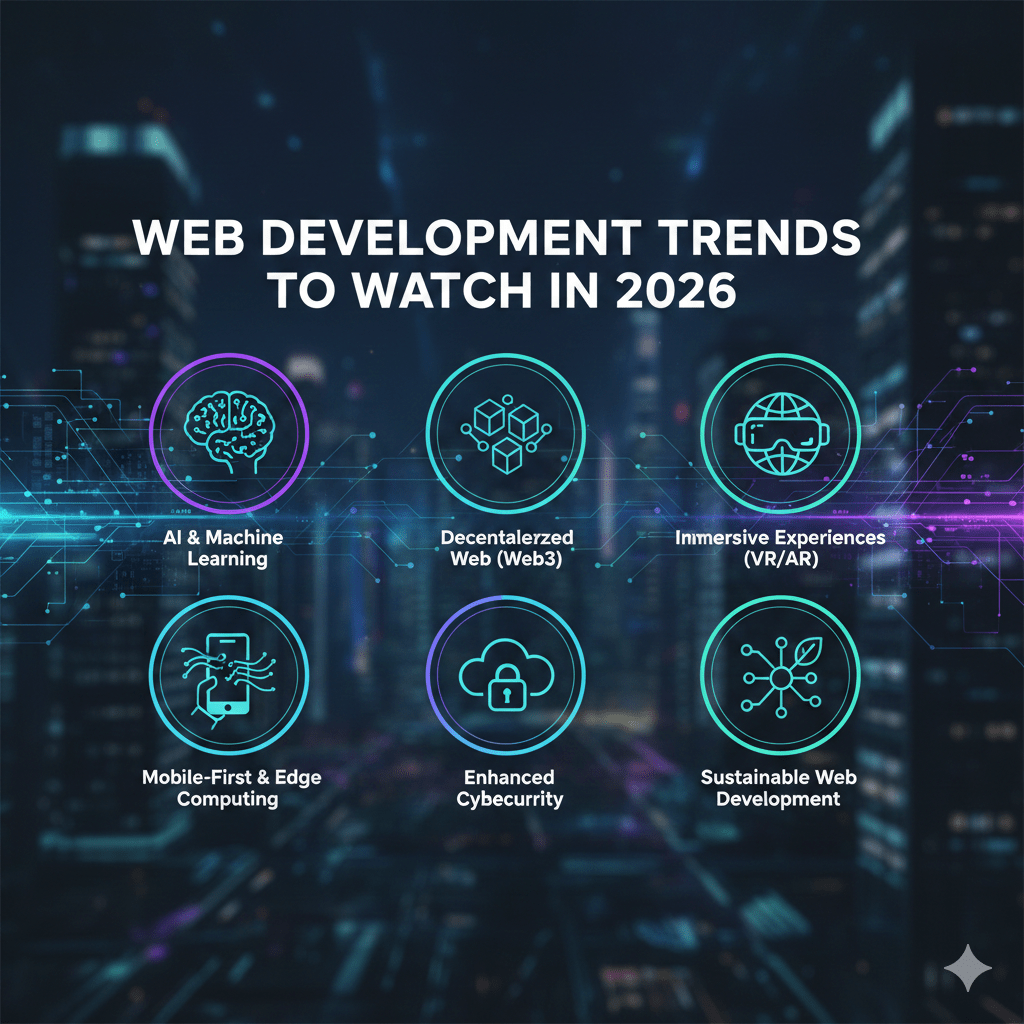
The web development ecosystem is evolving rapidly due to advancements in artificial intelligence, performance optimization, user experience design, and cybersecurity. As businesses increasingly depend on digital platforms for growth, staying ahead of web development trends is essential to build fast, scalable, and future-ready websites.
In 2026, web development will be shaped by AI-driven intelligence, composable architectures, accessibility-first design, and performance-focused engineering. Below are the most important trends every business, developer, and digital strategist should watch.
1. AI-Powered Web Development
Artificial Intelligence is becoming deeply integrated into web development workflows. AI tools are now capable of:
- Generating frontend and backend code
- Optimizing layouts based on user behavior
- Automating testing and bug detection
- Powering intelligent chatbots and personalization engines
Platforms like GitHub Copilot (https://github.com/features/copilot) and OpenAI-powered tools are already transforming how developers build and maintain websites.
2. WebAssembly (Wasm) for High-Performance Applications
WebAssembly enables near-native performance inside browsers, allowing developers to run complex applications efficiently on the web.
In 2026, WebAssembly will be widely used for:
- Browser-based games
- Video and audio editing tools
- Data visualization platforms
- Financial and scientific simulations
You can explore how WebAssembly works at the official site:
https://webassembly.org/
3. Progressive Web Apps (PWAs) Becoming the Default
Progressive Web Apps combine the best of websites and mobile apps by offering:
- Offline functionality
- Faster loading speeds
- Push notifications
- App-like user experience
Google continues to invest heavily in PWAs, making them a strong alternative to native apps. Learn more here:
https://web.dev/progressive-web-apps/
4. Serverless Architecture and Edge Computing
Serverless computing allows developers to build applications without managing infrastructure. When combined with edge computing, it delivers:
- Ultra-fast response times
- Reduced latency
- Improved global performance
- Automatic scalability
Platforms leading this space include AWS Lambda (https://aws.amazon.com/lambda/) and Cloudflare Workers (https://workers.cloudflare.com/).
5. Headless CMS and Composable Architecture
Traditional CMS platforms are being replaced by headless CMS solutions that separate content from presentation.
Popular headless CMS platforms include:
- Strapi – https://strapi.io/
- Sanity – https://www.sanity.io/
- Contentful – https://www.contentful.com/
Composable architecture allows developers to build flexible, API-driven websites that scale across web, mobile, and IoT platforms.
6. Modern Front-End Frameworks and Hybrid Rendering
Frameworks like Next.js, React, Vue, Svelte, and Astro are evolving rapidly.
Key priorities for 2026 include:
- Smaller JavaScript bundles
- Faster hydration
- Server-side rendering (SSR)
- Static site generation (SSG)
Next.js documentation:
https://nextjs.org/
7. Motion UI and Micro-Interactions
Subtle animations and micro-interactions enhance usability and engagement. Motion UI helps:
- Improve navigation clarity
- Guide user attention
- Provide instant feedback
- Strengthen brand identity
Tools like Framer Motion (https://www.framer.com/motion/) are widely used for advanced UI animations.
8. Accessibility-First Web Development
Accessibility is becoming a legal and ethical requirement, not just a best practice.
In 2026, websites must comply with WCAG standards, ensuring:
- Screen-reader compatibility
- Keyboard navigation
- High-contrast readability
- Inclusive design for all users
Learn about accessibility guidelines here:
https://www.w3.org/WAI/standards-guidelines/wcag/
9. Security-First Development Practices
With rising cyber threats, web security is now a core development requirement.
Key security trends include:
- Zero Trust architecture
- Secure APIs
- Encrypted data transmission
- Strong authentication systems
OWASP provides industry-leading security guidelines:
https://owasp.org/
10. Sustainable and Green Web Development
Performance optimization is now linked with sustainability. Green web development focuses on:
- Lightweight frameworks
- Optimized assets
- Reduced server load
- Energy-efficient hosting
Learn about sustainable web practices at:
https://www.thegreenwebfoundation.org/
11. Voice Search and Conversational Interfaces
With the rise of smart assistants, websites must adapt to voice-based interactions. This includes:
- Natural language content
- Structured data (Schema.org)
- Fast-loading pages
Voice search optimization guide:
https://developers.google.com/search/docs/appearance/structured-data
12. No-Code and Low-Code Development Platforms
No-code and low-code tools allow rapid development and prototyping, especially for MVPs and internal tools.
Popular platforms include:
- Webflow – https://webflow.com/
- Bubble – https://bubble.io/
These tools will complement traditional development rather than replace it.
Conclusion
Web development in 2026 will be driven by intelligence, performance, accessibility, security, and sustainability. Businesses that adopt modern architectures, AI-powered tools, and user-first design principles will gain a strong competitive advantage.
To build future-ready websites, scalable web applications, or SEO-optimized digital platforms, partner with TechsterTech — experts in modern web development, SEO, automation, and digital transformation.
Visit: https://techstertech.com