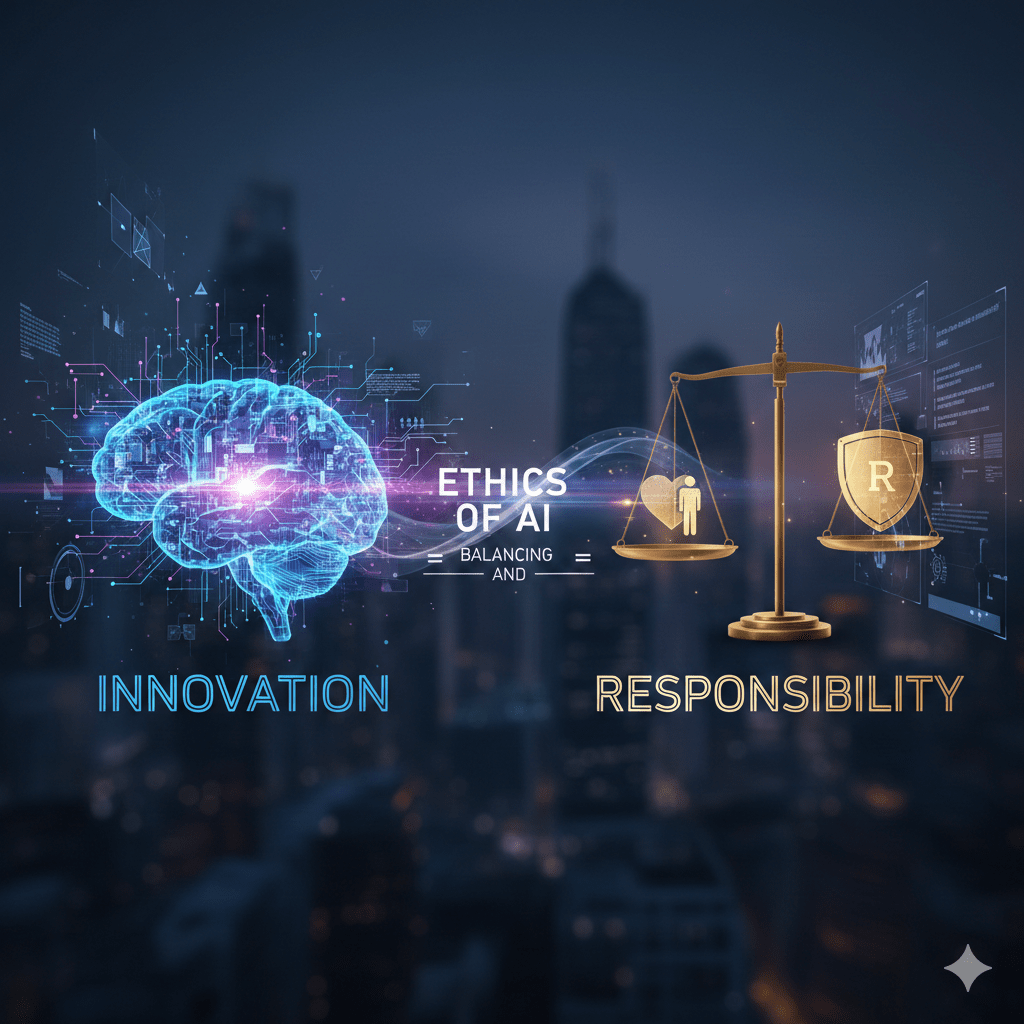
Artificial Intelligence (AI) is revolutionizing industries, enhancing efficiency, improving decision-making, and creating new opportunities for businesses worldwide. But as AI becomes more capable, powerful, and integrated into daily life, it also raises serious ethical questions. From data privacy to algorithmic bias and the potential loss of human oversight, AI presents a complex challenge:
How do we encourage technological innovation while ensuring responsible, ethical deployment?
This balance between innovation and responsibility is the core of modern AI ethics.
1. Why AI Ethics Matters Today
As AI systems influence healthcare, hiring, policing, finance, and personal communication, they increasingly shape people’s lives. Ethical AI ensures that these technologies:
- Protect human rights
- Avoid harmful outcomes
- Build trust among users
- Remain fair, transparent, and accountable
Without ethical guidelines, AI risks causing social, economic, and psychological harm.
2. Key Ethical Concerns in AI Development
a) Algorithmic Bias
AI systems learn from data. If the data contains biases, AI may:
- Discriminate against certain races or genders
- Make unfair hiring decisions
- Misidentify people in facial recognition
- Influence legal judgments inaccurately
Biased AI can reinforce inequalities rather than eliminate them.
b) Data Privacy and Surveillance
AI depends heavily on personal data.
Unethical or excessive data collection can lead to:
- Privacy violations
- Unwanted behavioral tracking
- Surveillance-based profiling
- Loss of user autonomy
Users must understand how their data is collected, stored, used, and protected.
c) Lack of Transparency
Many AI models — especially deep learning systems — operate like a “black box.”
This raises key questions:
- Why did the AI make this decision?
- Who is accountable when it goes wrong?
- Can users trust decisions they don’t understand?
Transparency is essential for public trust.
d) Job Automation and Workforce Disruption
AI is expected to replace millions of jobs while creating new ones.
The ethical challenge is managing:
- Job displacement
- Income inequality
- Reskilling and upskilling programs
- The future of human labor
A responsible AI ecosystem must prepare workers for an AI-driven future.
e) Autonomous Weapons & Military AI
AI in warfare introduces major risks:
- Misfired autonomous weapons
- Lack of human oversight
- Difficulty assigning accountability
- Potential misuse by hostile actors
This remains one of the most dangerous aspects of AI advancement.
f) Deepfakes and Misinformation
AI-generated media can be used to:
- Spread false information
- Manipulate elections
- Damage reputations
- Create fake audio/video of real individuals
Ethical frameworks must address the misuse of generative AI.
3. Principles for Ethical and Responsible AI
Governments, tech companies, and researchers recommend several guiding principles:
✔ Fairness
AI systems should treat all individuals equally, without discrimination.
✔ Accountability
Organizations must take responsibility for the outcomes of their AI models.
✔ Transparency
AI models should be explainable and understandable to users.
✔ Privacy Protection
Data collection must be secure, ethical, and consent-based.
✔ Human Oversight
Humans should remain in control of critical decisions, especially in healthcare, finance, and justice.
✔ Safety and Reliability
AI must perform consistently and safely, even in unexpected scenarios.
4. Balancing Innovation With Responsibility
a) Ethical Design at Every Stage
AI developers must embed ethics into AI development from the start — not as an afterthought.
b) Diverse and Inclusive Training Data
A wider range of data reduces biased outcomes.
c) Regulatory Frameworks
Governments need clear policies around:
- AI audits
- Data protection
- Algorithmic transparency
- Accountability standards
d) Collaboration Between Sectors
Businesses, governments, researchers, and civil society must work together to create trustworthy AI ecosystems.
e) Educating Developers and Users
Awareness about ethical AI must be widespread — among engineers, businesses, and consumers.
5. Can AI Be Both Innovative and Ethical?
Yes — as long as innovation is guided by strong moral frameworks.
Ethical AI does not slow innovation; it strengthens it by:
- Building public trust
- Reducing risks and misuse
- Creating sustainable AI systems
- Improving fairness and reliability
Responsible AI ensures that technology improves lives without compromising rights, freedoms, or safety.
Conclusion
Artificial Intelligence offers transformative potential, but its rapid advancement also presents serious ethical dilemmas. The future of AI depends not only on technological innovation but also on moral responsibility. By embracing transparency, fairness, accountability, and human oversight, we can ensure that AI evolves in a way that benefits society while minimizing harm.
For businesses looking to integrate AI tools, automation, or ethical digital strategies, visit TechsterTech.com — your trusted partner for responsible, future-ready digital solutions.