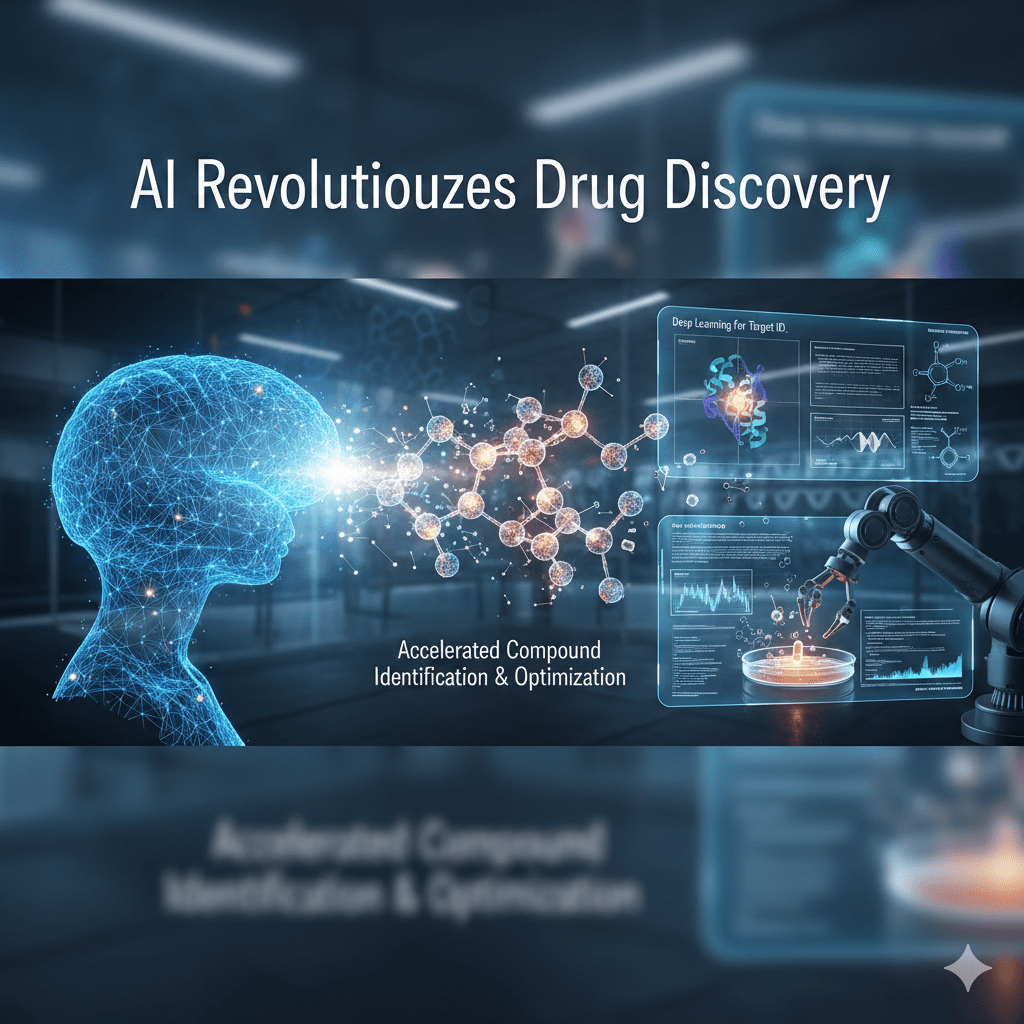
Drug discovery is one of the most complex, expensive, and time-consuming processes in the healthcare industry. Traditionally, it takes 10 to 15 years and billions of dollars to develop a new drug—often with a low success rate. But today, Artificial Intelligence (AI) is transforming this landscape by dramatically accelerating research, reducing costs, and improving accuracy.
From predicting molecular interactions to designing new drugs from scratch, AI has become a game-changing force that is reshaping the pharmaceutical world. In this blog, we explore how AI is revolutionizing drug discovery and why it represents the future of medical innovation.
1. Faster Identification of Drug Candidates
AI algorithms can analyze vast datasets—far beyond human capability—to identify promising drug molecules within minutes.
Traditionally, researchers test thousands of compounds manually, but AI automates this step by:
- Predicting which molecules may interact with disease targets
- Eliminating poor candidates early
- Prioritizing molecules with the highest potential
This reduces the early-stage discovery timeline from years to mere weeks or months.
2. AI-Powered Molecular Design
AI doesn’t just search existing molecules—it can design new ones.
Generative AI models like:
- GANs (Generative Adversarial Networks)
- Transformer-based models
- Deep learning molecular generators
create novel compounds with optimized properties such as:
- Lower toxicity
- Better absorption
- Higher stability
- Stronger binding affinity
This opens the door to drugs that would not have been discovered through human research alone.
3. Predicting Drug–Target Interactions
Understanding how a drug interacts with a biological target is crucial. AI models can:
- Simulate molecular interactions
- Predict binding strength
- Forecast biological response
- Identify side effects
AI dramatically improves accuracy by analyzing millions of data points, including protein structures, genomic data, and biochemical patterns.
4. Accelerating Clinical Trials
Clinical trials are often the most expensive and time-consuming stage.
AI helps optimize them by:
- Selecting ideal candidates for trials
- Predicting patient responses
- Monitoring trial progress
- Identifying adverse reactions early
- Enhancing success rates with data-driven insights
AI reduces trial attrition and increases the likelihood of FDA approval.
5. AI in Repurposing Existing Drugs
During COVID-19, AI played a strong role in identifying compounds that could be repurposed, reducing the time needed for treatment research.
AI helps:
- Analyze known drugs for new uses
- Predict cross-disease applicability
- Reduce development time
- Lower R&D costs
Repurposed drugs reach patients faster due to existing safety data.
6. Enhanced Safety and Toxicity Prediction
Before human testing, AI can predict:
- Toxicity levels
- Organ sensitivity
- Long-term side effects
- DNA interaction risks
This ensures only the safest candidates progress to clinical trials, reducing human risk and improving overall drug safety.
7. Integration of Genomics and Personalized Medicine
AI analyzes genomic datasets to:
- Identify patient subgroups
- Predict who will benefit from a drug
- Customize treatments
- Enable precision medicine
This brings us closer to personalized drugs, tailored to an individual’s genetic profile.
8. Automation in Laboratory Research
AI-powered robots and automation systems now handle:
- Liquid handling
- Sample preparation
- Imaging and analysis
- High-throughput screening
This minimizes human error and accelerates laboratory work.
9. Cost Reduction Across the Entire Pipeline
AI helps pharmaceutical companies reduce costs by:
- Minimizing failed experiments
- Shortening trial timelines
- Improving candidate selection
- Lowering operational costs
- Reducing need for physical testing early on
Experts estimate that AI could cut drug development costs by up to 40%.
10. Real-World Examples of AI in Drug Discovery
DeepMind’s AlphaFold
Accurately predicts protein structures, solving a 50-year biological challenge.
Insilico Medicine
Used AI to design a new fibrosis drug in months instead of years.
BenevolentAI
Identified existing drugs that could treat COVID-19 using AI analysis.
These breakthroughs prove that AI is not just theoretical—it is already transforming medicine.
Conclusion
Artificial Intelligence is revolutionizing drug discovery by making it faster, cheaper, and more accurate. From designing new molecules to predicting drug behavior and accelerating clinical trials, AI is bringing unprecedented innovation to the pharmaceutical industry. As technology continues to advance, AI-driven drug discovery will become the new standard, offering hope for faster cures and breakthrough treatments.
Businesses that adopt AI early will gain a competitive edge in R&D, innovation, and medical advancement.
For companies seeking AI integration, workflow automation, and digital transformation strategies, visit TechsterTech.com — your trusted partner in future-ready digital solutions.