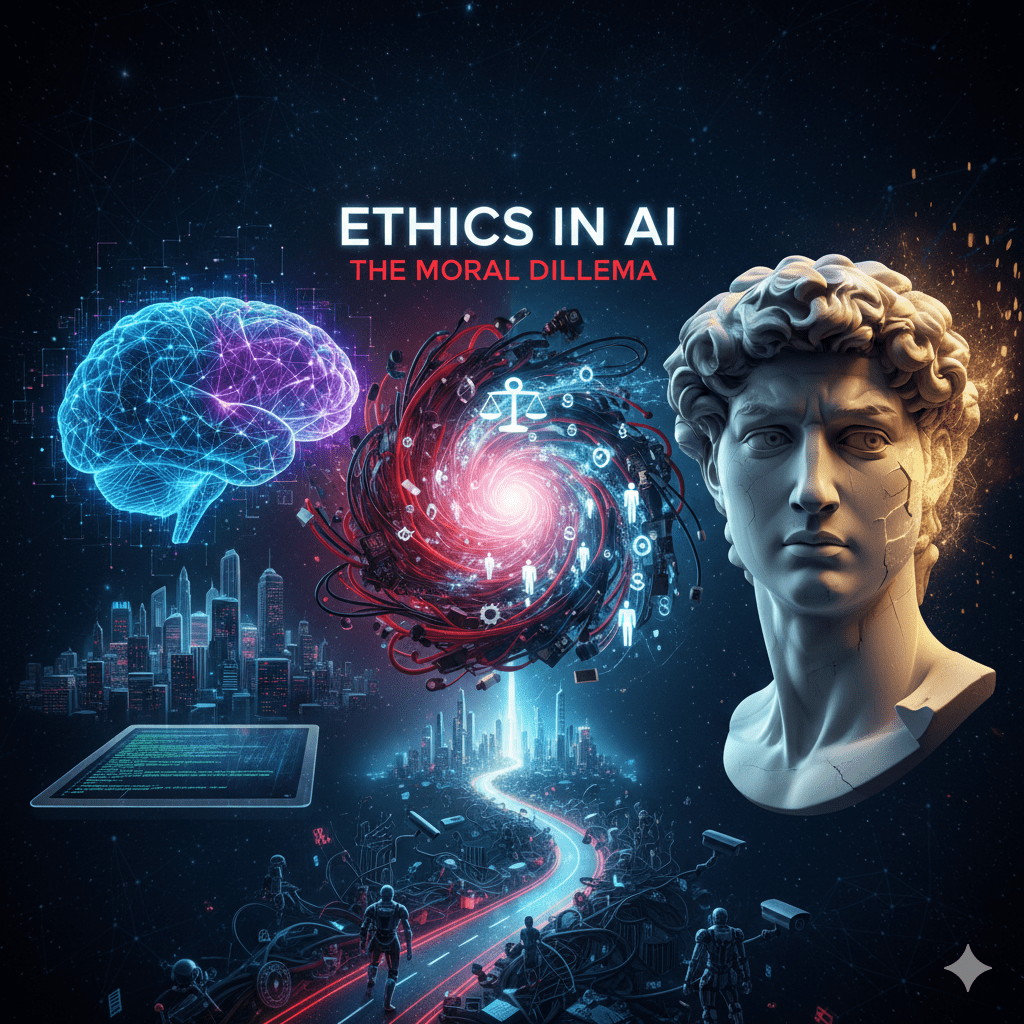
Artificial Intelligence (AI) now influences nearly every aspect of modern life — from healthcare and finance to marketing, transportation, policing, and education. As AI systems grow more advanced, they also raise significant ethical questions. These concerns shape how AI should be used, who controls it, and what responsibilities developers and governments must uphold.
The moral dilemma surrounding AI is not about rejecting technology but ensuring that powerful systems operate safely, fairly, transparently, and without harming human rights. Understanding AI ethics is essential for building a future that balances innovation with accountability.
1. What Is AI Ethics?
AI ethics refers to the principles and guidelines that govern the development and use of artificial intelligence. It covers:
- Fairness
- Transparency
- Accountability
- Privacy
- Safety
- Inclusiveness
- Human oversight
The central goal is to ensure AI supports human well-being rather than undermining it.
2. Key Ethical Challenges in Artificial Intelligence
a) Bias and Discrimination
AI systems often learn from historical data. If that data contains bias, AI may:
- Deny loans unfairly
- Misidentify individuals
- Prioritize certain groups over others
- Reinforce stereotypes
Real-world example: Facial recognition tools have shown higher error rates for darker skin tones, raising concerns about unfair policing.
b) Privacy Violations
AI systems collect and analyze huge amounts of personal data.
This leads to critical questions:
- Who controls the data?
- How secure is it?
- Do users truly consent to its use?
Data misuse can lead to surveillance, identity theft, or loss of personal freedom.
c) Lack of Transparency (The “Black Box” Problem)
Many AI models make decisions humans cannot fully explain.
This becomes problematic when AI influences:
- Hiring
- Medical diagnoses
- Loan approvals
- Criminal sentencing
If a system cannot explain why it made a choice, accountability becomes difficult.
d) Job Displacement
Automation powered by AI can replace human jobs in:
- Manufacturing
- Retail
- Transportation
- Customer support
- Data entry
- Marketing analytics
The ethical dilemma lies in balancing innovation with economic disruption.
e) Autonomous Weapons
AI-powered military technologies raise alarming ethical questions:
- Who is responsible if an autonomous weapon misfires?
- Should machines have the power to take human life?
- Can such systems be controlled?
This is one of the most debated ethical issues globally.
f) Deepfakes and Misinformation
AI-generated content can fabricate:
- Videos
- Voices
- Photos
- News
These tools can manipulate public opinion, harm reputations, and spread misinformation at massive scale.
3. Frameworks for Ethical AI
Governments, organizations, and researchers have proposed ethical guidelines, including:
✔ Human-centric AI
AI should prioritize human rights, dignity, and autonomy.
✔ Transparency and Explainability
AI systems must clearly explain how decisions are made.
✔ Fairness and Inclusion
AI must avoid discriminating against any group.
✔ Accountability
Developers and organizations must be responsible for AI failures.
✔ Data Protection & Privacy
User data must be collected and used responsibly.
✔ Safety & Reliability
AI must perform consistently, even in unexpected scenarios.
4. Building Ethical AI: What Needs to Change?
a) Better Data Governance
Organizations must ensure data is:
- Clean
- Diverse
- Free from bias
- Collected ethically
b) Human Oversight
AI should assist, not replace, human decision-making in critical sectors.
c) Regulations and Policies
Governments need clear frameworks for:
- AI audits
- Transparency requirements
- Accountability laws
- Consumer data protection
d) Ethical Training for Developers
Teams building AI systems must understand the moral impact of their work.
e) Global Collaboration
AI ethics should not differ dramatically by region. A universal ethical framework can help minimize misuse.
5. The Future: Can AI Be Truly Ethical?
Creating perfectly ethical AI may never be possible because:
- Human values differ across cultures
- Technology evolves faster than laws
- Systems learn unpredictably
However, with consistent effort, AI can become far more responsible and aligned with human well-being.
The goal is not perfection — it’s progress.
Ethical AI is about reducing harm, increasing fairness, and ensuring technology benefits society as a whole.
Conclusion
Artificial Intelligence brings immense potential but also significant moral dilemmas. As AI becomes more integrated into daily life, balancing innovation with ethics is crucial. Building transparent, fair, and accountable AI systems will define how societies use technology for decades to come.
Businesses, governments, and developers must collaborate to ensure AI empowers humanity — rather than endangering it.
For professional assistance with ethical marketing automation, AI adoption, SEO, and digital transformation strategies, visit TechsterTech.com — your trusted partner in responsible digital growth.