Artificial Intelligence (AI) has evolved at lightning speed over the past decade — powering self-driving cars, voice assistants, medical diagnostics, marketing automation, and more. But despite its progress, today’s AI systems are still classified as narrow AI — meaning they can perform specific tasks extremely well, but cannot replicate the full range of human reasoning and adaptability.
This leads to one of the biggest questions in technology today:
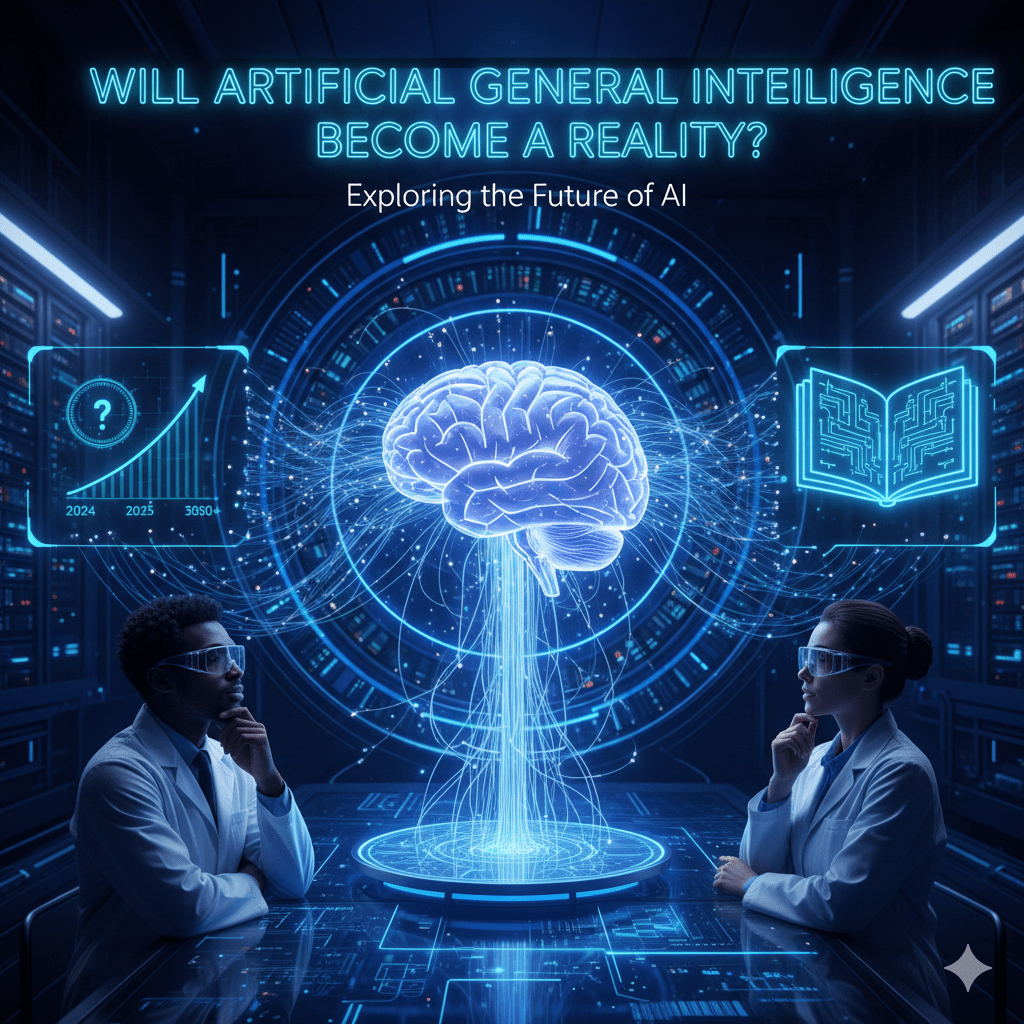
Will Artificial General Intelligence (AGI) — an AI system that can think, learn, and reason like a human — ever become a reality?
While the debate continues, researchers, scientists, and industry leaders have presented both optimistic and cautious arguments. Let’s explore both sides.
What Is Artificial General Intelligence (AGI)?
AGI refers to AI systems capable of:
- Understanding any task a human can perform
- Applying knowledge across different domains
- Learning autonomously with minimal data
- Reasoning and making decisions like humans
- Exhibiting creativity, emotional understanding, and adaptability
In simple terms, AGI aims to match or exceed human intelligence across all areas — not just specific tasks.
Arguments Suggesting AGI Could Become a Reality
1. Rapid Progress in Machine Learning
In recent years, models have shown:
- Near-human writing
- Code generation
- Complex reasoning abilities
- Understanding of images, audio, and video
The exponential pace of innovation fuels optimism about human-like intelligence emerging sooner than expected.
2. Advanced Neural Architectures
Technologies like:
- Transformer models
- Deep learning
- Multi-modal AI
- Reinforcement learning
are moving AI closer to generalized reasoning.
Some researchers believe AGI may emerge from a combination of these models rather than a single breakthrough.
3. Massive Computational Power
With the rise of:
- Quantum computing
- High-performance GPUs
- Distributed cloud computing
AI systems are becoming faster, more efficient, and capable of analyzing huge datasets — a key requirement for AGI.
4. Self-learning Systems
AI is developing methods to:
- Learn with fewer examples
- Train itself using synthetic data
- Improve performance without human supervision
Self-learning is considered a foundational step toward AGI.
Arguments Suggesting AGI May Not Become a Reality Soon
1. We Still Lack Understanding of Human Intelligence
Neuroscience has not fully decoded:
- How consciousness arises
- How memory truly works
- How emotions influence decisions
- How humans learn abstract concepts
If we cannot fully understand human intelligence, replicating it remains extremely challenging.
2. Ethical and Safety Concerns
AGI raises major risks:
- Uncontrolled decision-making
- Economic displacement
- Autonomous power beyond human control
- Difficulty establishing ethical boundaries
Many researchers caution against rushing AGI development without strong safety frameworks.
3. Current AI Still Lacks True Reasoning
Even the most advanced AI models today:
- Make errors in basic logic
- Hallucinate incorrect information
- Lack self-awareness
- Cannot understand intent the way humans do
These gaps indicate that AGI may require foundational breakthroughs—not just incremental improvements.
4. Resource Limitations
Building AGI requires:
- Massive datasets
- Enormous computational resources
- Highly specialized talent
These practical constraints slow down AGI development significantly.
When Might AGI Become a Reality?
Experts disagree widely:
- Some predict AGI by 2030
- Others estimate 2050–2100
- Many believe AGI may never be fully achieved
The uncertainty reflects the complexity and unpredictability of technological evolution.
The Middle Ground: Augmented Intelligence
A more realistic and near-term approach is Augmented Intelligence, where AI enhances but does not replace human intelligence. This hybrid model is already reshaping:
- Medicine
- Education
- Marketing
- Finance
- Engineering
- Research & development
It may become the dominant path forward while AGI continues to be explored.
Conclusion
Will AGI become a reality? Possibly — but the timeline is uncertain. Despite impressive advancements in machine learning, computational power, and reasoning models, replicating human intelligence remains one of the most complex challenges in science and technology.
What we can say with confidence is that AI will continue transforming industries, improving productivity, and expanding human potential long before true AGI arrives.
Businesses and individuals who adapt early will remain ahead of the curve as technology evolves.
For expert support with AI-powered marketing, automation, SEO, or digital transformation, visit TechsterTech.com — your trusted digital growth partner.