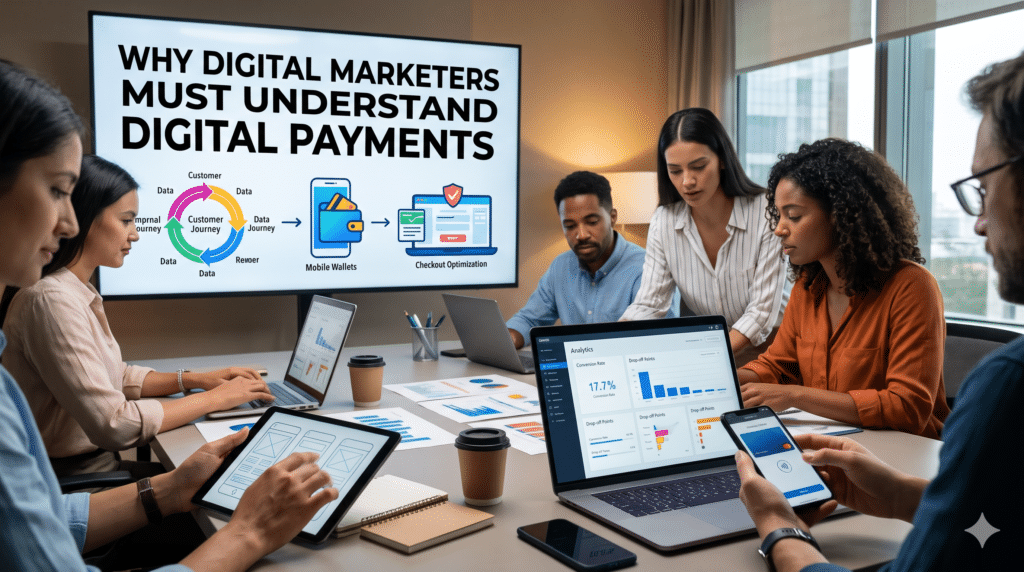
Digital marketing is no longer limited to attracting website visitors, generating leads, or increasing social media engagement. Today, businesses must also understand what happens after a potential customer clicks an advertisement, visits a website, selects a product, and decides to make a purchase.
One of the most important parts of this customer journey is digital payment.
With the rapid growth of online shopping, mobile banking, Unified Payments Interface (UPI), digital wallets, and payment gateways, digital transactions have become an essential part of India’s business ecosystem.
For digital marketers, understanding digital payments is no longer optional. It directly influences customer experience, conversion rates, advertising performance, customer trust, and business revenue.
Imagine running a successful advertising campaign that generates thousands of website visitors. Customers add products to their shopping carts, proceed to checkout, and then abandon their purchases because the payment process is complicated or their preferred payment option is unavailable.
In this situation, the marketing campaign may be successful at attracting customers, but the business still loses potential revenue.
This is why digital marketers must understand how digital payments work and how payment experiences influence customer behaviour.
In this article, we will explore the importance of digital payments in digital marketing, the payment technologies businesses should understand, and practical strategies for improving conversions.
1. What Are Digital Payments?
Digital payments refer to transactions in which money is transferred electronically without the physical exchange of cash.
Customers can make digital payments through various methods, including:
- UPI payments.
- Debit and credit cards.
- Internet banking.
- Mobile banking applications.
- Digital wallets.
- QR code payments.
- Payment links.
- Buy Now, Pay Later (BNPL) services, where available.
- Recurring digital payments and subscriptions.
In India, digital payment systems have transformed how customers purchase products and services.
For example, a customer purchasing clothing from an e-commerce website may complete the transaction through UPI, while another customer may prefer a credit card or net banking.
Digital marketers must understand these payment preferences because they influence how customers interact with online businesses.
Useful official resources:
2. Why Digital Payments Matter in Digital Marketing
Digital payments connect marketing activities with actual business transactions.
Traditional marketing measurement often focused on impressions, clicks, and enquiries. Modern digital marketing increasingly requires businesses to understand completed purchases and the revenue generated from campaigns.
Digital payment knowledge helps marketers understand several important areas.
A. Improving Conversion Rates
A customer may be interested in a product but abandon the purchase if the checkout process is confusing.
Offering familiar and convenient payment options can reduce unnecessary friction.
For example, an Indian e-commerce business that supports UPI, cards, and net banking gives customers more flexibility than a business offering only one payment method.
B. Understanding Customer Preferences
Payment behaviour can provide useful insights into how customers prefer to complete transactions.
For example:
- Some customers prefer UPI for everyday purchases.
- Some customers prefer credit cards for higher-value transactions.
- Some customers use net banking for business-related payments.
- Some customers prefer cash on delivery where available.
Marketers can use aggregated, appropriately collected payment insights to improve customer experience and campaign planning.
C. Connecting Advertising With Revenue
An advertisement generating 1,000 clicks is not necessarily successful if very few visitors complete their purchases.
Digital marketers need to connect advertising performance with completed transactions.
Payment confirmation events, properly configured analytics, and reliable order records help businesses measure actual results.
D. Building Customer Trust
Customers are more likely to complete transactions when the payment process appears reliable, transparent, and secure.
Clear pricing, recognised payment options, transparent refund policies, and trustworthy checkout experiences can strengthen confidence.
3. Understanding UPI and Its Importance in the Indian Market
The Unified Payments Interface (UPI) has become a major component of India’s digital payment ecosystem.
It enables users to transfer money between participating bank accounts through supported payment applications.
For businesses, UPI offers a convenient payment option for customers who prefer making transactions through mobile applications.
Examples of UPI-enabled payment applications include:
Digital marketers should understand how UPI affects the customer journey.
For example, a business running an Instagram advertisement for a product can direct interested customers to an e-commerce website where they can select UPI as their payment method.
A smooth transition from advertisement to checkout can improve the overall purchasing experience.
However, UPI availability, transaction limits, payment success rates, and supported features depend on the participating banks and payment providers.
4. Payment Gateways: What Digital Marketers Should Know
A payment gateway is a technology service that helps businesses accept and process online payments through supported payment methods.
For an e-commerce business, a payment gateway connects the checkout experience with payment processing services.
Popular payment gateway providers operating in India include:
Digital marketers do not necessarily need to understand the technical architecture of payment gateways, but they should know how these systems affect customer experience.
Important considerations include:
Payment options: Does the gateway support the payment methods preferred by your audience?
Mobile experience: Is the checkout process convenient on smartphones?
Payment success rate: How often do initiated transactions successfully complete?
Transaction experience: Are payment instructions clear and easy to follow?
Refund process: Can customers understand how refunds are handled?
Analytics integration: Can completed purchases be accurately recorded in the business’s analytics systems?
These factors can directly affect the performance of digital campaigns.
5. How Payment Experience Influences Customer Behaviour
Customer experience does not end when someone clicks an advertisement.
It continues through product discovery, website navigation, cart selection, checkout, payment confirmation, and post-purchase communication.
Consider this customer journey:
<escape>Advertisement → Website Visit → Product Selection → Add to Cart → Checkout → Payment → Order Confirmation</escape>
Problems at any stage can cause customers to abandon their purchase.
For example:
- A website loads slowly during checkout.
- The preferred payment method is unavailable.
- The customer is redirected to an unfamiliar payment page.
- Additional charges appear unexpectedly.
- Payment confirmation takes too long.
- The customer does not understand whether the transaction succeeded.
Digital marketers should work with website developers and payment providers to identify and reduce these problems.
A better payment experience can support higher conversion rates and improved customer satisfaction.
6. The Role of Digital Payments in E-Commerce Marketing
For e-commerce businesses, payment integration is an essential part of the sales process.
A well-designed e-commerce website should make it easy for customers to discover products, compare options, add items to their carts, and complete payments.
Digital marketers should understand the following elements.
Multiple Payment Options
Offer payment methods relevant to your target audience.
These may include UPI, debit cards, credit cards, net banking, and other supported options.
Transparent Pricing
Display the final payable amount clearly before the customer proceeds with payment.
Unexpected delivery fees, taxes, or additional charges can discourage purchases.
Mobile-Friendly Checkout
Many customers shop through smartphones. Ensure that checkout forms, payment buttons, and instructions work smoothly on mobile devices.
Order Confirmation
Customers should receive clear confirmation after a successful transaction.
Depending on the business, this may include an order number, payment status, invoice, and delivery information.
Refund and Cancellation Information
Make refund and cancellation policies easy to find and understand.
These details help establish trust before customers make a purchase.
7. Digital Payments and Conversion Rate Optimisation
Conversion Rate Optimisation (CRO) involves improving a website or digital experience so that a higher proportion of visitors complete a desired action.
Understanding digital payments helps marketers identify checkout-related barriers.
For example, an e-commerce business may receive 10,000 website visitors in a month, but only 200 customers complete a purchase.
Its purchase conversion rate is:
[
\frac{200}{10,000}\times100=2%
]
Now suppose the business identifies payment-related problems and improves its checkout experience. If completed purchases increase to 300 while traffic remains unchanged:
[
\frac{300}{10,000}\times100=3%
]
The conversion rate has increased from 2% to 3%.
This is a 1 percentage-point improvement, or a 50% relative increase in purchases.
Digital marketers can improve payment-related conversions by:
- Reducing unnecessary checkout steps.
- Providing familiar payment options.
- Improving mobile checkout design.
- Displaying shipping costs and taxes transparently.
- Offering clear payment instructions.
- Improving payment error messages.
- Making customer support accessible.
- Testing different checkout experiences.
The objective should be to identify genuine customer problems rather than simply adding more payment options.
8. How Digital Marketers Can Use Payment Data
Payment-related information can provide valuable insights into campaign performance and customer behaviour.
For example, marketers may analyse:
- Number of completed transactions.
- Payment success and failure rates.
- Average order value.
- Cart abandonment rates.
- Refund rates.
- Revenue by marketing channel.
- Revenue by product category.
- Repeat purchase behaviour.
However, marketers should work with aggregated or appropriately authorised data and avoid collecting or exposing sensitive payment credentials.
Example: Campaign Performance Analysis
Imagine an online store runs two advertising campaigns.
| Metric | Campaign A | Campaign B |
|---|---|---|
| Website visitors | 5,000 | 4,000 |
| Add-to-cart events | 500 | 600 |
| Completed purchases | 100 | 180 |
| Advertising cost | ₹20,000 | ₹24,000 |
| Revenue | ₹80,000 | ₹1,44,000 |
Purchase conversion rates:
- Campaign A: 2%
- Campaign B: 4.5%
Return on Ad Spend (ROAS):
- Campaign A: 4x
- Campaign B: 6x
[
ROAS=\frac{\text{Revenue from Ads}}{\text{Advertising Cost}}
]
Campaign B generates fewer visitors but delivers a higher purchase conversion rate and stronger ROAS.
This illustrates why digital marketers should evaluate actual transactions rather than relying exclusively on clicks and impressions.
9. The Importance of Payment Security and Customer Trust
Digital payment security is an important part of the online customer experience.
Customers may hesitate to make purchases if they are uncertain about the safety of a payment page or the handling of their financial information.
Digital marketers should understand basic payment security principles.
These include:
Secure connections: Websites should use HTTPS to protect data transmitted between users and the website.
Trusted payment providers: Use reputable payment service providers with appropriate security and compliance arrangements.
Clear payment instructions: Explain the payment process and avoid confusing customers.
Fraud awareness: Educate customers about fake payment links, phishing attempts, and fraudulent requests for OTPs or UPI PINs.
Privacy protection: Do not collect or publish unnecessary personal or financial information.
Transparent refunds: Communicate refund timelines and procedures accurately.
For authoritative information, consult:
A particularly important point for Indian customers: UPI PINs and OTPs should never be shared with anyone. Customers should verify payment requests carefully before approving transactions.
10. Digital Payments and Subscription-Based Business Models
Digital payments are also important for businesses that offer recurring services.
Examples include:
- Online learning platforms.
- Software subscriptions.
- Streaming services.
- Membership websites.
- Digital publications.
- Fitness programmes.
- Professional service subscriptions.
These businesses may use recurring payment arrangements or supported subscription billing systems.
Digital marketers should understand:
- Subscription pricing.
- Billing frequency.
- Free trials.
- Renewal reminders.
- Payment failures.
- Cancellation policies.
- Refund procedures.
- Customer retention.
For example, a software company offering a monthly subscription may lose customers when recurring payments fail.
Marketers can work with product and customer-support teams to develop clear renewal communication and appropriate payment recovery processes.
All recurring payment arrangements must comply with applicable payment regulations and provider requirements.
11. Digital Payments and the Future of Personalised Marketing
As digital commerce develops, payment experiences and marketing technology are becoming increasingly connected.
Businesses can use customer journey data to improve communication and personalise relevant experiences.
For example:
Abandoned cart communication: Send a permitted reminder to customers who added products to their cart but did not complete their purchase.
Post-purchase communication: Provide order updates, invoices, and useful product information.
Loyalty programmes: Offer relevant rewards to returning customers.
Personalised offers: Recommend products based on appropriate customer preferences and purchase history.
Payment-related support: Help customers understand transaction status and refund procedures.
Personalisation should be based on lawful data processing, appropriate consent where required, and clear privacy practices.
12. Useful Digital Payment and Analytics Tools for Marketers
Digital marketers should be familiar with the platforms that connect marketing campaigns, online transactions, and business analytics.
| Tool or platform | Marketing relevance | Official website |
|---|---|---|
| Razorpay | Online payment acceptance and transaction management | Razorpay |
| Cashfree Payments | Payment collection and payment solutions | Cashfree |
| PayU | Online payment processing | PayU |
| Google Analytics 4 | Website and conversion measurement | GA4 |
| Google Tag Manager | Managing website tracking tags | GTM |
| WooCommerce | E-commerce store management and payment integrations | WooCommerce |
| Shopify | E-commerce store and checkout management | Shopify |
These tools serve different purposes. Payment providers process transactions, while analytics and tag management platforms help measure customer interactions.
A properly configured integration is necessary to connect the two reliably.
13. Common Mistakes Digital Marketers Should Avoid
Businesses sometimes invest heavily in advertising but overlook the payment experience.
Here are some common mistakes:
- Ignoring payment preferences: Not offering payment methods that customers commonly use.
- Focusing only on website traffic: Measuring clicks without tracking completed purchases.
- Overlooking checkout problems: Failing to identify payment failures and abandoned transactions.
- Ignoring mobile users: Providing a poor payment experience on smartphones.
- Hiding additional charges: Revealing unexpected costs at the final checkout stage.
- Using unreliable integrations: Choosing payment solutions without evaluating their suitability and support.
- Ignoring refund communication: Leaving customers uncertain about cancelled or refunded orders.
- Misinterpreting payment failures: Treating every failed transaction as a lack of customer interest.
- Collecting unnecessary sensitive data: Exposing the business to avoidable privacy and security risks.
- Failing to test payment journeys: Not checking whether transactions and analytics events work correctly.
14. A Practical Checklist for Digital Marketers
Before launching an e-commerce advertising campaign, use this checklist to evaluate the payment journey.
- The website is mobile-friendly.
- The checkout process is easy to understand.
- Relevant payment methods are available.
- The final payable amount is clearly displayed.
- The payment gateway is properly integrated.
- Successful and failed payment journeys have been tested.
- Customers receive appropriate transaction confirmation.
- Refund and cancellation policies are accessible.
- Website conversion tracking is configured correctly.
- Payment-related customer support is available.
- Privacy and security requirements are addressed.
This checklist can help marketing and development teams identify problems before they affect campaign performance.
Conclusion
Digital marketing and digital payments are closely connected. Attracting customers through advertisements is only one part of the online business journey. Helping those customers complete secure, convenient, and successful transactions is equally important.
Digital marketers who understand UPI, payment gateways, checkout optimisation, transaction analytics, and payment security can make better marketing decisions and contribute more directly to business growth.
As India’s digital economy continues to evolve, knowledge of digital payments will become an increasingly valuable skill for SEO professionals, performance marketers, social media managers, e-commerce specialists, and digital marketing consultants.
The ultimate objective is simple: create a seamless journey from the first advertisement to the final successful transaction.
Want to build an e-commerce website that turns visitors into customers?
TechsterTech helps businesses establish and strengthen their digital presence through professional website design and development, SEO, e-commerce solutions, website audits, optimisation, maintenance, and IT consultancy.
Whether you need a WooCommerce store, payment gateway integration, a conversion-focused landing page, or a complete website development solution, TechsterTech can help you build a stronger digital foundation.