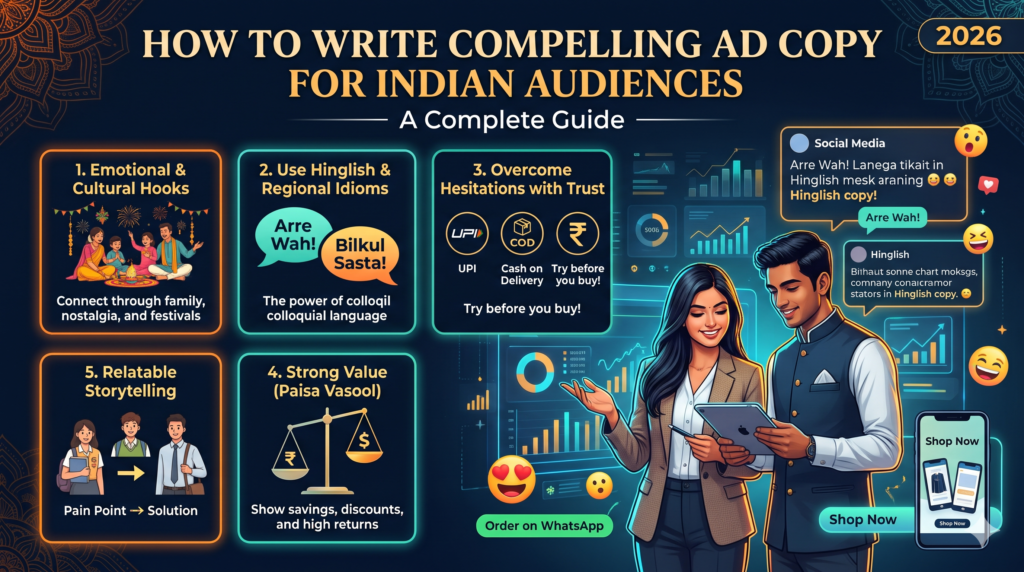
India is one of the most diverse and dynamic digital markets in the world. With millions of consumers using smartphones, social media platforms, search engines, and e-commerce websites, businesses have enormous opportunities to reach potential customers through digital advertising.
However, writing advertisements for Indian audiences requires more than translating English content into Hindi or adding popular phrases to promotional messages.
India has diverse languages, cultures, income groups, purchasing habits, regional preferences, and consumer expectations. An advertisement that performs well in Mumbai may not generate the same response in Jaipur, Chennai, Kolkata, or Guwahati.
This makes audience understanding and cultural relevance essential components of successful advertising.
Whether you are running Google Ads, Meta Ads, YouTube campaigns, or regional digital promotions, compelling ad copy can help your business attract attention, communicate value, build trust, and encourage customers to take action.
In this guide, we will explore how to write effective ad copy for Indian audiences, with practical examples, copywriting formulas, platform-specific recommendations, and strategies for improving conversions.
1. Understand the Diversity of Indian Audiences
The first step in writing effective advertising copy is understanding that India is not a single homogeneous market.
Consumer preferences can differ significantly based on:
- Geography and regional culture.
- Language and communication preferences.
- Age and lifestyle.
- Income and purchasing power.
- Education and digital literacy.
- Urban, semi-urban, and rural environments.
- Product requirements and buying behaviour.
For example, an advertisement promoting traditional clothing may need different messaging for customers in Rajasthan, Punjab, West Bengal, and Tamil Nadu.
Similarly, a technology company targeting business owners in metropolitan cities may use different language from a company promoting affordable digital services to small businesses in smaller towns.
Practical recommendation: Divide your audience into meaningful segments before writing advertisements. Avoid using one generic message for every customer.
2. Choose the Right Language for Your Target Audience
Language plays an important role in building familiarity and trust.
Although English is widely used in Indian business and digital communication, many consumers prefer Hindi or their regional language when evaluating products and services.
Consider the following language strategies:
English Advertising Copy
Suitable for:
- Professional services.
- B2B products.
- Technology companies.
- Higher education.
- Corporate audiences.
- Premium products and services.
Example:
“Build a stronger online presence with professional website development and SEO solutions.”
Hindi Advertising Copy
Suitable for:
- Local businesses.
- Consumer products.
- Regional service providers.
- General awareness campaigns.
- Businesses targeting Hindi-speaking audiences.
Example:
“अपने बिजनेस को ऑनलाइन पहचान दिलाएं। आज ही अपनी प्रोफेशनल वेबसाइट बनवाएं।”
Hinglish Advertising Copy
Hinglish combines Hindi and English in a conversational style.
It can be useful for brands targeting audiences comfortable with both languages.
Example:
“Business ko online grow karna hai? Get your professional website today!”
Regional Language Advertising
Depending on your target market, consider:
- Marathi for Maharashtra.
- Tamil for Tamil Nadu.
- Telugu for Andhra Pradesh and Telangana.
- Bengali for West Bengal.
- Kannada for Karnataka.
- Gujarati for Gujarat.
- Malayalam for Kerala.
- Punjabi for Punjab.
Do not assume that everyone in a particular state prefers only its most widely spoken regional language. Use audience research and campaign data to guide language selection.
Useful language resources:
Machine translation can support initial drafting, but native-language review is important to avoid awkward phrasing, unintended meanings, and cultural mistakes.
3. Focus on Customer Problems, Not Just Product Features
One of the biggest mistakes in advertising is talking too much about the product and too little about the customer’s needs.
Customers are generally interested in understanding how a product or service can improve their situation.
Consider this example:
Feature-focused copy:
“We provide professional website development services.”
Benefit-focused copy:
“Get a professional website that helps your business build credibility and reach more customers online.”
The second version explains why the service matters to the customer.
Before writing an advertisement, identify:
- What problem does the customer face?
- What solution does your product provide?
- What makes your offer different?
- Why should the customer act now?
- What evidence can support your claims?
A useful copywriting principle is to translate product features into practical customer benefits.
4. Use Cultural Relevance Without Stereotyping
Indian audiences respond to messages that feel familiar and relevant to their experiences.
Cultural references, festivals, family occasions, local events, and regional expressions can make advertisements more engaging.
For example:
- A clothing brand may create a festive campaign around Diwali.
- A sweets business may promote gift boxes during Raksha Bandhan.
- A travel company may advertise family holiday packages during school vacations.
- A fitness brand may launch a New Year fitness challenge.
- A local business may use regional festivals to connect with nearby customers.
However, cultural relevance should be genuine.
Avoid stereotypes, religious insensitivity, political controversy, and assumptions about people’s lifestyles.
A good campaign celebrates its audience without reducing them to simplistic cultural identities.
5. Use the Right Emotional Triggers
Emotions influence how people respond to advertising messages.
Effective ad copy can appeal to emotions such as confidence, convenience, aspiration, belonging, security, and excitement.
Here are some examples.
| Emotional trigger | Example advertising message |
|---|---|
| Aspiration | Take your business to the next level. |
| Convenience | Get everything you need in one place. |
| Trust | Quality service backed by transparent support. |
| Savings | Enjoy more value with our special offer. |
| Confidence | Make smarter choices with expert guidance. |
| Belonging | Join a community that shares your passion. |
| Urgency | Limited-period offer. Explore the details today. |
Use emotional messaging responsibly. Avoid creating unnecessary fear, false urgency, or unrealistic expectations.
6. Use Numbers, Offers and Clear Value Propositions
Indian consumers often compare products, prices, features, and available offers before making purchasing decisions.
A clear value proposition helps customers understand what they receive and why the offer is relevant.
For example:
Generic copy:
“Buy our premium products today.”
More compelling copy:
“Explore our premium collection with convenient online ordering and reliable customer support.”
If your business has a genuine promotional offer, communicate it clearly.
Examples:
- Flat 20% off on selected products.
- Free delivery on eligible orders.
- Complimentary website consultation.
- Special introductory pricing.
- Limited-period festive collection.
Always mention important conditions, eligibility requirements, and exclusions where applicable.
Never advertise discounts, savings, guarantees, or product benefits that cannot be substantiated.
7. Write Strong Headlines That Capture Attention
The headline is often the first element people notice in an advertisement.
A good headline should communicate the main benefit quickly.
Here are some useful headline formulas.
Problem-Solution Formula
Identify a customer problem and present the solution.
Example:
“Struggling to Get Customers Online? Build Your Digital Presence Today.”
Benefit-Driven Formula
Highlight the outcome customers want.
Example:
“Grow Your Business With a Professional Website.”
Question-Based Formula
Ask a question that reflects the audience’s needs.
Example:
“Is Your Business Ready for the Digital World?”
Offer-Based Formula
Communicate a genuine promotional benefit.
Example:
“Get Your Business Website With Our Special Launch Offer.”
Curiosity-Based Formula
Encourage customers to learn more without misleading them.
Example:
“5 Website Mistakes That May Be Costing Your Business Customers.”
Use different headline variations and test which ones generate meaningful results.
8. Write Platform-Specific Ad Copy
The same advertisement should not necessarily be used across every digital platform.
Each platform has different audience behaviour, content formats, and advertising requirements.
Google Search Ads
Google Search Ads target people actively searching for products or services.
Your copy should closely match the search query and clearly communicate the offer.
Example: Website Development Services
Headline ideas:
- Professional Website Development
- Affordable Business Websites
- Build Your Website With Experts
Description:
“Get a professional, mobile-friendly website for your business. Explore website development and maintenance solutions. Contact us today.”
Website: Google Ads
Facebook and Instagram Ads
Meta advertisements are useful for reaching audiences based on available targeting options and encouraging discovery.
The copy should quickly capture attention and communicate the main benefit.
Example: Local Business Promotion
“Your customers are online. Is your business ready to reach them?
Build a professional website that showcases your services, strengthens your credibility, and helps customers connect with you.
Get started today!”
Platforms: Facebook | Instagram | Meta Business Suite
YouTube Ads
YouTube advertisements often need a strong opening message to capture attention.
Example:
“Still managing your business without a professional website? Discover how a well-designed website can help customers find your services and connect with your business.”
Website: YouTube Ads
WhatsApp Marketing
WhatsApp can support customer communication and promotional campaigns where users have provided appropriate consent.
Example:
“Hello! Looking to take your business online? We offer professional website development and SEO services to help you strengthen your digital presence. Reply to learn more.”
Business platform: WhatsApp Business
Ensure that promotional messages comply with applicable consent, privacy, and messaging requirements.
9. Use Localisation to Improve Advertising Performance
Localisation goes beyond translating words. It involves adapting the complete advertising message to a particular market.
For example, a campaign targeting customers in Jaipur may include references to local business needs, regional preferences, or relevant local occasions.
A campaign targeting Bengaluru may require different language choices and customer examples.
Localisation can involve:
- Regional language copy.
- Local customer testimonials.
- Location-specific offers.
- Relevant cultural references.
- Local currency and pricing.
- Regionally appropriate images.
- Local customer support information.
Example:
Generic advertisement:
“Get the best digital marketing services for your business.”
Localised advertisement:
“Jaipur businesses, take your brand online with professional website development and SEO services.”
The second example creates a more direct connection with a specific audience.
However, local references should be used only when the business genuinely serves that location.
10. Build Trust Through Social Proof
Trust is an important consideration when customers evaluate unfamiliar brands or services.
Advertising copy can become more persuasive when supported by genuine evidence.
Useful trust-building elements include:
- Verified customer reviews.
- Genuine testimonials.
- Product ratings.
- Relevant certifications.
- Case studies.
- Demonstrations.
- Clear return or refund policies.
- Transparent pricing and service conditions.
Example:
“Helping businesses strengthen their online presence through professional website development and SEO solutions.”
If you have verified customer feedback or measurable results, you can include them with appropriate context and permission.
Never create fake testimonials, fabricated ratings, or misleading claims about customer results.
11. Use A/B Testing to Improve Ad Copy
Even experienced marketers cannot always predict which advertisement will perform best.
A/B testing helps compare different versions of an advertisement using actual campaign data.
For example, create two versions of an advertisement for the same audience.
Version A – Benefit-focused
“Build a Professional Website for Your Business.”
Version B – Problem-focused
“Customers Can’t Find Your Business Online? Let’s Fix That.”
Test different elements, such as:
- Headlines.
- Descriptions.
- Calls to action.
- Offers.
- Images and videos.
- Language variations.
- Landing page messaging.
Keep the audience, objective, and other conditions as consistent as possible when comparing variations.
Measure meaningful outcomes such as click-through rate, cost per lead, conversion rate, and return on advertising spend.
Useful resources:
Do not select a winning advertisement based only on clicks if your actual objective is generating qualified leads or sales.
12. Common Ad Copywriting Mistakes to Avoid
Even a well-funded advertising campaign can underperform because of weak messaging.
Avoid these mistakes:
- Using generic language: Messages that could apply to any business rarely communicate a strong reason to choose your brand.
- Overusing English jargon: Complex terminology can confuse audiences unfamiliar with industry-specific language.
- Ignoring regional preferences: A single message may not suit every Indian market.
- Making unrealistic promises: Avoid guaranteed results without reliable evidence.
- Writing lengthy headlines: Important benefits should be communicated quickly.
- Using weak calls to action: Tell customers what they should do next.
- Ignoring mobile users: Keep the message readable on smaller screens.
- Copying competitors: Understand what works, but develop your own brand voice.
- Ignoring landing pages: The advertisement and landing page should communicate a consistent offer.
- Failing to test: Regularly review performance and improve underperforming copy.
13. Ready-to-Use Ad Copy Examples for Indian Businesses
Here are practical examples that businesses can adapt for their campaigns.
Example 1: Digital Marketing Agency
Headline: Grow Your Business With Digital Marketing
Ad Copy:
“Want to reach more customers online? Discover professional SEO, website development, and digital marketing solutions designed to strengthen your online presence.
Let’s grow your business together!”
CTA: Get Started Now
Example 2: E-Commerce Business
Headline: Discover Products You’ll Love
Ad Copy:
“Explore our latest collection and find products that match your style and everyday needs. Browse online and enjoy a convenient shopping experience.”
CTA: Shop Now
Example 3: Fitness Centre
Headline: Start Your Fitness Journey Today
Ad Copy:
“Ready to make fitness part of your lifestyle? Join our fitness community and take the first step towards a stronger, healthier routine.”
CTA: Enquire Now
Example 4: Educational Institute
Headline: Build Skills for a Better Future
Ad Copy:
“Looking to improve your knowledge and career opportunities? Explore practical learning programmes designed to help you develop valuable skills.”
CTA: Explore Courses
Example 5: Local Service Business
Headline: Reliable Services in Your City
Ad Copy:
“Looking for professional and dependable service? Connect with our team for quality solutions, transparent communication, and personalised support.”
CTA: Contact Us
14. The Future of Ad Copywriting in India: AI and Personalisation
Artificial intelligence is changing how marketers research audiences, generate advertising variations, and optimise campaigns.
AI tools can help marketers:
- Generate headline ideas.
- Create regional language drafts.
- Develop different advertising angles.
- Summarise customer feedback.
- Identify recurring audience concerns.
- Generate content variations.
- Analyse campaign performance.
Useful AI tools include:
However, AI-generated copy should not be published without review.
Indian language nuances, cultural context, factual accuracy, brand tone, and advertising compliance require human judgement.
A practical approach is to use AI for research and first drafts, then refine the copy with local market knowledge and performance data.
Conclusion
Writing compelling ad copy for Indian audiences requires a combination of creativity, cultural understanding, customer research, and marketing strategy.
India’s linguistic and cultural diversity makes localisation especially important. Businesses should understand their target customers, communicate genuine benefits, use familiar language, and build trust through transparent messaging.
Whether you are advertising through Google, Instagram, Facebook, YouTube, or WhatsApp, the most effective copy is the copy that connects with the right audience and gives them a clear reason to take action.
Remember: successful advertising is not about saying more. It is about communicating the right message to the right person at the right time.
Need professional support for your digital marketing and online growth?
TechsterTech helps businesses strengthen their digital presence through professional website design and development, SEO, website audits, website optimisation, maintenance, e-commerce solutions, and IT consultancy.
From creating conversion-focused landing pages to improving your website’s search visibility, TechsterTech can help your business build a stronger digital foundation.