Introduction
In today’s competitive digital world, startups rely heavily on data-driven decision-making to survive and scale. Whether you are running an eCommerce business, SaaS platform, wellness brand, or digital service company, tracking the right Key Performance Indicators (KPIs) helps you understand performance, customer behavior, profitability, and growth opportunities.
For startup founders, digital KPIs act as a roadmap for business success. Monitoring these metrics regularly enables smarter marketing investments, better customer retention, and improved operational efficiency.
What are Digital KPIs?
Digital KPIs (Key Performance Indicators) are measurable values that indicate how effectively a business is achieving its digital goals. These metrics help startups evaluate the performance of marketing campaigns, website traffic, customer engagement, and revenue generation.
Tracking the right KPIs allows startup founders to:
- Measure growth and performance
- Identify strengths and weaknesses
- Improve marketing ROI
- Optimize customer acquisition strategies
- Increase profitability
Essential Digital KPIs Every Startup Should Track
1. Website Traffic
Website traffic measures how many users visit your website. It is one of the most fundamental KPIs for any online business.
Important Metrics:
- Total Visitors
- Unique Visitors
- Page Views
- Traffic Sources
Why It Matters:
Understanding traffic sources helps identify which marketing channels are driving the best results.
Tools:
- Google Analytics
- Google Search Console
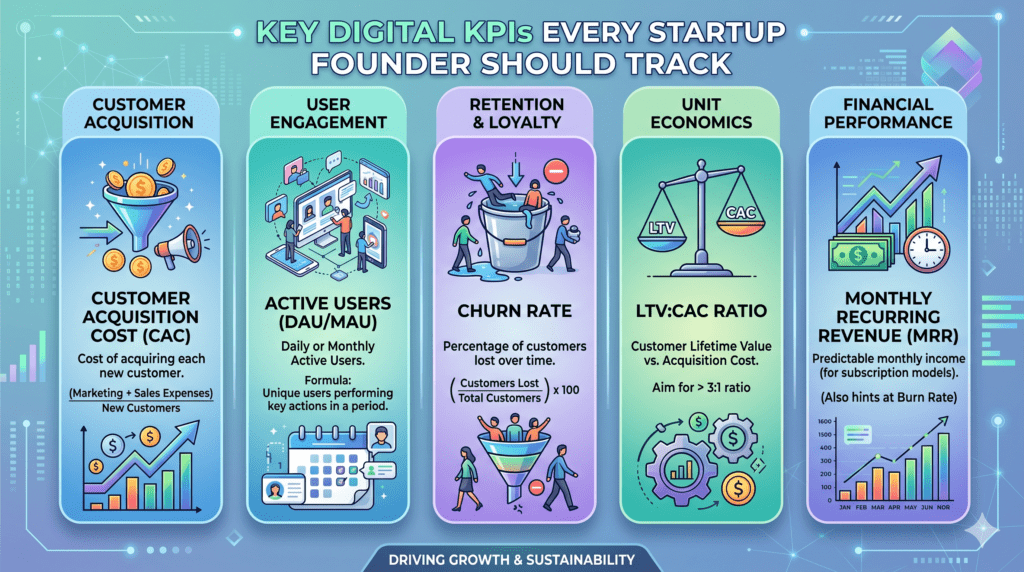
2. Customer Acquisition Cost (CAC)
CAC measures how much it costs to acquire a new customer.
Formula:
CAC = Total Marketing & Sales Expenses ÷ Number of New Customers
Why It Matters:
A low CAC indicates efficient marketing strategies, while a high CAC may signal overspending or ineffective campaigns.
3. Customer Lifetime Value (CLV or LTV)
Customer Lifetime Value estimates the total revenue a customer generates during their relationship with the business.
Why It Matters:
If your LTV is higher than your CAC, your business model is sustainable.
Example:
Subscription businesses and wellness brands benefit significantly from repeat customers and long-term engagement.
4. Conversion Rate
Conversion rate measures the percentage of users who complete a desired action.
Examples of Conversions:
- Product Purchase
- Newsletter Signup
- Contact Form Submission
- Subscription Registration
Formula:
Conversion Rate = (Conversions ÷ Total Visitors) × 100
Why It Matters:
A higher conversion rate means your website and marketing campaigns are effective.
5. Bounce Rate
Bounce rate refers to the percentage of visitors who leave your website without interacting further.
Why It Matters:
A high bounce rate may indicate:
- Poor website design
- Slow loading speed
- Irrelevant content
- Weak user experience
Improving website quality can significantly reduce bounce rates.
6. Search Engine Rankings
SEO performance is critical for long-term organic growth.
Track:
- Keyword Rankings
- Organic Traffic
- Backlinks
- Domain Authority
Why It Matters:
Better rankings increase visibility, traffic, and sales without relying heavily on paid advertising.
7. Social Media Engagement
Social media KPIs help startups understand audience interaction and brand awareness.
Key Metrics:
- Likes and Shares
- Comments
- Follower Growth
- Reach and Impressions
- Click-Through Rate (CTR)
Why It Matters:
Strong engagement indicates audience trust and interest in your brand.
8. Email Marketing Performance
Email marketing remains one of the highest ROI digital channels.
Track:
- Open Rate
- Click Rate
- Unsubscribe Rate
- Conversion Rate
Why It Matters:
These metrics help optimize email campaigns and customer communication strategies.
9. Return on Ad Spend (ROAS)
ROAS measures the revenue generated from advertising campaigns.
Formula:
ROAS = Revenue from Ads ÷ Advertising Cost
Why It Matters:
This KPI determines whether your paid campaigns are profitable.
10. Customer Retention Rate
Retention rate measures how many customers continue using your products or services over time.
Why It Matters:
Retaining customers is often cheaper than acquiring new ones. Businesses with strong retention enjoy better profitability and stability.
Importance of KPIs for Startup Growth
Tracking KPIs enables founders to:
- Make informed business decisions
- Reduce unnecessary spending
- Improve customer satisfaction
- Scale marketing efforts efficiently
- Achieve long-term business sustainability
Without KPI monitoring, startups often struggle with unclear strategies and wasted resources.
Best Tools for Tracking Digital KPIs
Here are some popular tools startups can use:
| Tool | Purpose |
|---|---|
| Google Analytics | Website traffic analysis |
| Google Search Console | SEO monitoring |
| SEMrush | Keyword and competitor analysis |
| HubSpot | CRM and marketing automation |
| Meta Business Suite | Social media analytics |
| Mailchimp | Email marketing analytics |
Digital KPI Strategy for Wellness & Ayurvedic Brands
For wellness brands like naturopathayurvedicremedies.com, tracking digital KPIs is essential to improve online visibility and customer trust.
For example, monitoring:
- Organic traffic to product pages
- Conversion rate of health blogs
- Repeat customer purchases
- Social media engagement on wellness tips
Conclusion
Digital KPIs are the foundation of smart startup growth. By tracking essential metrics such as traffic, conversion rates, CAC, LTV, and engagement, startup founders can make data-driven decisions that improve performance and profitability.
In a highly competitive digital marketplace, startups that consistently analyze and optimize their KPIs gain a significant advantage over competitors.
At TechsterTech, we specialize in SEO, web development, digital marketing, and business growth strategies for startups and online businesses. Our expert solutions help brands improve website performance, increase conversions, and achieve sustainable digital growth. Visit our website to take your startup to the next level.