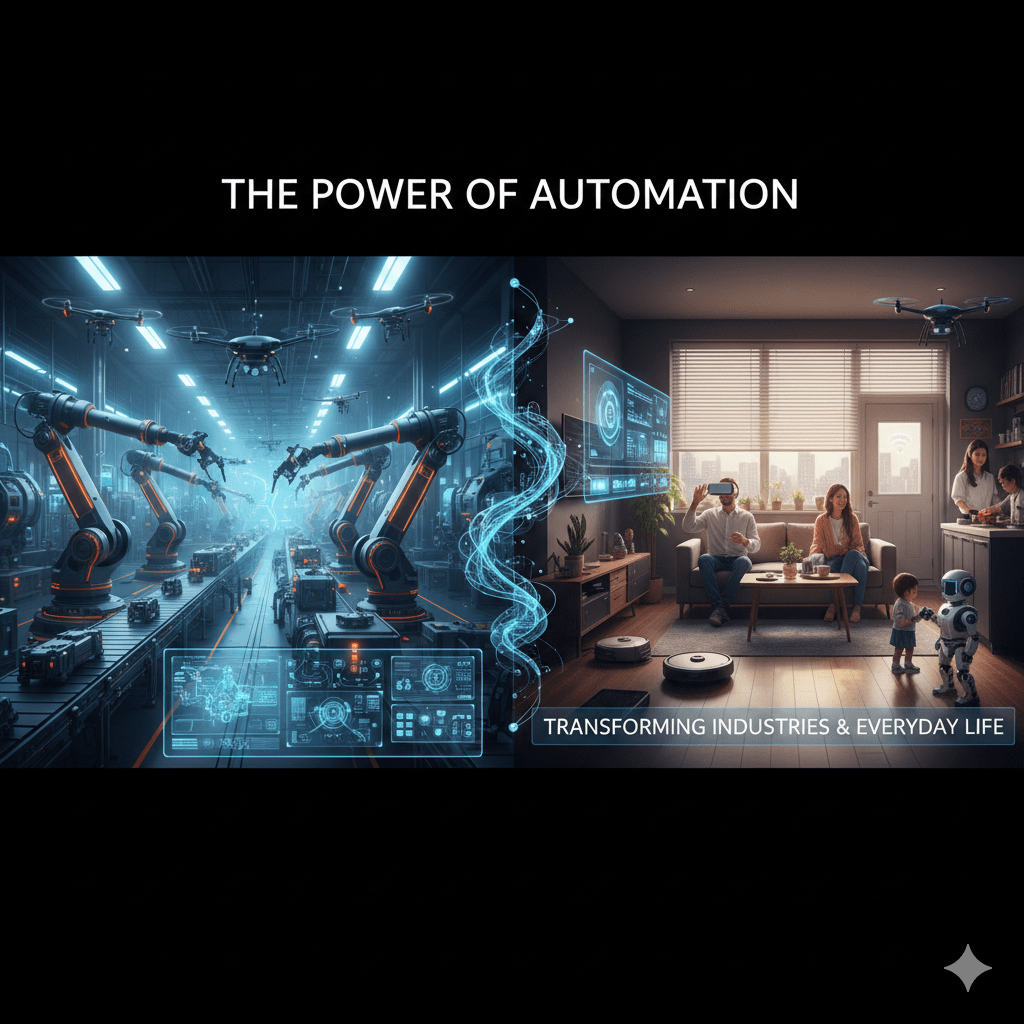
Automation is no longer a futuristic concept—it is a fundamental part of how the modern world operates. From manufacturing and healthcare to finance, logistics, and even our personal daily routines, automation has become a powerful force driving efficiency, accuracy, and innovation.
As AI, robotics, and digital systems continue to evolve, automation is transforming industries and the way people work and live. It enhances productivity, reduces errors, speeds up processes, and enables humans to focus on complex, creative, and strategic tasks.
In this blog, we explore how automation is reshaping industries and influencing everyday life in 2025 and beyond.
1. Automation in Manufacturing: Speed, Precision, and Consistency
Automation has revolutionized manufacturing by enabling:
- Faster production cycles
- Increased safety
- Precision-based assembly
- Reduced operational costs
- Quality consistency
Robots handle repetitive tasks such as assembly, welding, and packaging.
AI-powered automation also predicts machine failures, reducing downtime through predictive maintenance.
This results in higher efficiency and fewer production errors, making modern factories smarter and more scalable.
2. Automation in Healthcare: Smarter, Safer, Faster Care
AI and automation are streamlining healthcare operations through:
- Automated patient monitoring
- Robotic surgeries
- Appointment scheduling
- Medical imaging analysis
- Personalized treatment recommendations
Systems can analyze data faster than humans, enabling early disease detection, improving diagnostics, and enhancing treatment accuracy.
Automation is also making administrative tasks more efficient, allowing healthcare professionals to focus more on patient care.
3. Automation in Finance: Accuracy and Fraud Prevention
Banks and fintech firms rely heavily on automation for:
- Fraud detection
- Risk assessment
- Customer onboarding
- Loan processing
- Automated trading
AI algorithms detect unusual transactions instantly and help prevent financial crime.
Automation also improves customer experiences through instant approvals, chatbots, and personalized financial insights.
4. Automation in Retail: Personalized and Efficient Shopping
Retailers use automation to improve both online and offline shopping experiences:
- Inventory management systems
- Automated checkout
- AI product recommendations
- Supply chain automation
- Chatbots for customer service
Warehouse automation ensures faster delivery, while AI-driven insights help retailers understand customer preferences and optimize stock levels.
5. Automation in Logistics: Faster Deliveries and Smarter Tracking
Logistics companies benefit from automation through:
- Route optimization
- Autonomous vehicles and drones
- Real-time tracking
- Automated sorting centers
- Predictive demand forecasting
These innovations reduce delivery times, lower costs, and improve overall supply chain visibility.
6. Automation in Marketing: Data-Driven Campaigns
Marketing automation tools help brands execute campaigns more efficiently:
- Automated email sequences
- Personalized product suggestions
- Lead scoring
- CRM workflows
- Social media scheduling
- AI-generated insights
By automating repetitive tasks, marketers can focus on strategy, creativity, and customer engagement.
7. Automation in Everyday Life
Automation has quietly entered our daily routines through:
- Smart home devices (lights, thermostats, locks)
- Voice assistants like Alexa and Google Assistant
- Automated bill payments
- Ride-hailing algorithms
- Personalized content recommendations
- Fitness and health trackers
These technologies simplify tasks, increase convenience, and improve lifestyle efficiency.
8. Benefits of Automation
✔ Increased Productivity
Automation handles repetitive work, enabling faster output.
✔ Cost Reduction
Businesses save money through efficiency and reduced labor-intensive work.
✔ Improved Accuracy
Automated systems reduce human errors.
✔ Enhanced Safety
Dangerous tasks can be assigned to robots instead of humans.
✔ Better Customer Experience
Automation leads to faster support, personalization, and smoother processes.
9. Challenges and Ethical Considerations
Despite its advantages, automation brings challenges:
- Job displacement and workforce reskilling needs
- Privacy and data security concerns
- High initial implementation costs
- Over-reliance on technology
- Ethical dilemmas with autonomous systems
Balancing innovation with responsibility is essential for sustainable automation.
Conclusion
Automation is a transformative force shaping industries and everyday life. It boosts efficiency, enhances accuracy, accelerates innovation, and unlocks new levels of productivity. From manufacturing floors to smartphones in our pockets, automation enables smarter decisions and smoother experiences.
As automation continues to advance, businesses and individuals must embrace it responsibly—balancing technological progress with human-centric values.
For organizations looking to automate workflows, optimize marketing, or implement AI-powered systems, visit TechsterTech.com — your trusted partner for digital transformation and growth.