Launching a new product is an exciting but challenging process. A great product alone does not guarantee success. Customers need to know that the product exists, understand its benefits, trust the brand, and have a simple way to purchase it.
This is where digital marketing plays a crucial role.
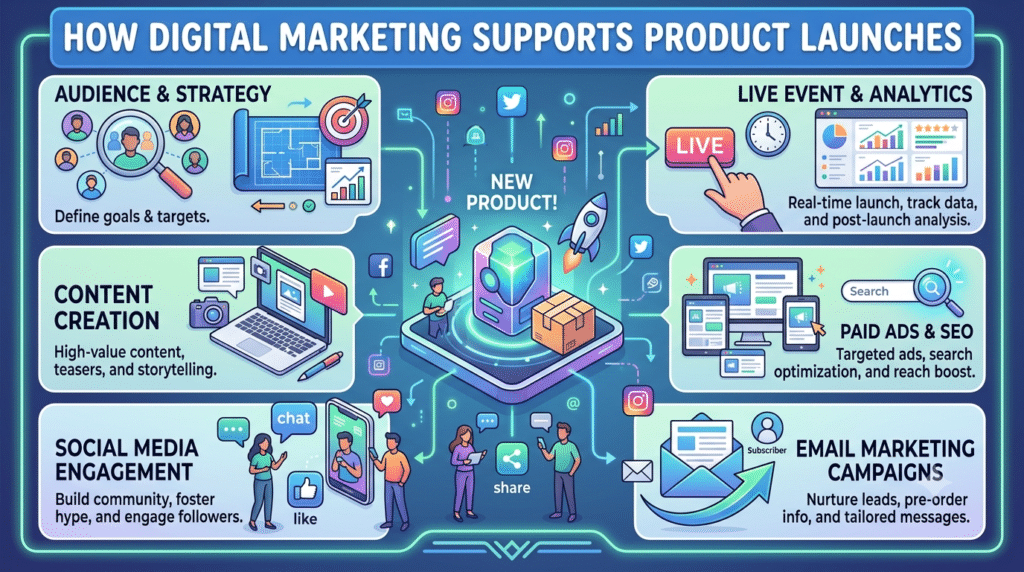
From creating awareness before launch to generating leads, building anticipation, driving sales, and measuring results after launch, digital marketing can support almost every stage of a product launch.
In this article, we explore how businesses can use digital marketing to create successful product launches.
1. Build Awareness Before the Launch
A successful product launch often begins before the product becomes available.
Businesses can create anticipation through:
- Social media teasers
- Countdown campaigns
- Blog posts
- Email announcements
- Short-form videos
- Landing pages
- Influencer collaborations
Platforms such as Instagram, Facebook, YouTube, and LinkedIn can help introduce the product to potential customers.
The objective is to make the target audience aware of the upcoming product before launch day.
2. Create a Dedicated Product Landing Page
A dedicated landing page gives customers one place to learn about the product.
It can include:
- Product benefits
- Features
- Images and videos
- Pricing
- Customer testimonials
- Frequently asked questions
- Launch date
- Pre-order or registration form
- Call-to-action
Landing-page platforms such as WordPress, Elementor, and Unbounce can help businesses create product-focused pages.
A well-designed landing page should be fast, mobile-friendly, easy to navigate, and focused on one primary objective.
3. Use SEO to Attract Organic Traffic
Search engine optimization can help potential customers discover the product through Google and other search engines.
Before launching, research:
- Product-related keywords
- Customer problems
- Search intent
- Competitor content
- Frequently asked questions
Useful tools include:
Businesses can also publish educational articles answering questions related to the product.
For example, a company launching a new fitness product could publish:
“How to Choose the Right Home Fitness Equipment”
The article can naturally introduce the new product as one possible solution.
4. Build an Email Marketing List
Email marketing can be extremely useful during a product launch because it allows businesses to communicate directly with interested customers.
A launch email sequence might include:
Email 1: Announcement
“Something New Is Coming”
Email 2: Problem
Explain the problem the product solves.
Email 3: Solution
Introduce the product and its key benefits.
Email 4: Launch
Announce that the product is now available.
Email 5: Follow-Up
Answer common questions and encourage interested customers to take action.
Tools such as Mailchimp, Brevo, and HubSpot can help manage email campaigns and automation.
5. Use Social Media Marketing
Social media allows brands to demonstrate products visually and interact directly with potential customers.
Content ideas include:
- Product demonstrations
- Behind-the-scenes videos
- Customer questions
- Tutorials
- Before-and-after content
- Founder stories
- Product comparisons
- Short videos
- Live demonstrations
For visually oriented products, platforms such as Instagram and YouTube can be particularly useful.
6. Run Paid Advertising Campaigns
Paid advertising can accelerate product awareness and reach targeted audiences.
Businesses can use:
Google Ads
Google Ads can reach users actively searching for related products or solutions.
Meta Ads
Facebook and Instagram advertising can help businesses reach selected audiences based on available targeting options.
LinkedIn Ads
For B2B products, LinkedIn can help businesses reach professional audiences.
The important point is to connect advertising objectives with measurable outcomes such as leads, purchases, registrations, or qualified traffic.
7. Use Influencer Marketing
Influencers and content creators can introduce products to established communities.
Depending on the product, businesses can collaborate with:
- Industry experts
- Micro-influencers
- Regional creators
- Product reviewers
- YouTubers
- Professional creators
Instead of choosing influencers only by follower count, businesses should consider:
- Audience relevance
- Engagement quality
- Content quality
- Audience location
- Brand alignment
The goal should be reaching the right audience, not simply the largest audience.
8. Create Video Content
Video can demonstrate how a product works more effectively than text alone.
Product-launch videos can include:
- Product demonstrations
- Tutorials
- Unboxing videos
- Customer testimonials
- Founder explanations
- Frequently asked questions
Businesses can publish videos through:
Short-form video can be particularly useful for generating awareness, while longer videos can provide detailed product demonstrations.
9. Use WhatsApp for Product Launch Communication
For businesses serving customers in India and other markets where messaging apps are widely used, WhatsApp can be an important communication channel.
WhatsApp Business can support:
- Product announcements
- Customer questions
- Catalog sharing
- Order communication
- Customer support
Official website:
Businesses should follow applicable privacy, consent, and messaging requirements when communicating with customers.
10. Generate Social Proof
Customers often want evidence that a product works before purchasing.
Digital marketing can help collect and display:
- Reviews
- Testimonials
- Case studies
- User-generated content
- Expert opinions
- Demonstrations
For a new product, early customers can provide valuable feedback that can later become part of marketing materials—with appropriate permission.
11. Use Retargeting to Reconnect With Interested Customers
Many visitors will not purchase during their first interaction.
Retargeting can help businesses reconnect with people who have previously interacted with their website, advertising, or other digital properties, subject to platform rules and applicable privacy requirements.
For example:
Customer visits product page → leaves website → later sees relevant reminder advertisement.
This can help maintain product awareness during the consideration stage.
12. Measure Product Launch Performance
One of the biggest advantages of digital marketing is measurability.
Businesses can monitor:
- Website visitors
- Traffic sources
- Leads
- Conversion rate
- Cost per lead
- Customer acquisition cost
- Sales
- Return on ad spend
- Email open and click rates
Useful measurement tools include:
Using tracking parameters such as UTM tags can also help identify which campaigns and channels generate traffic and conversions.
A Simple Digital Product Launch Framework
Businesses can organize their launch into four stages:
Stage 1 — Pre-Launch
- Research the audience
- Build awareness
- Create landing page
- Collect leads
- Publish educational content
Stage 2 — Launch
- Announce the product
- Activate email campaigns
- Launch advertisements
- Publish social content
- Work with relevant creators
Stage 3 — Post-Launch
- Collect reviews
- Retarget interested visitors
- Answer customer questions
- Publish demonstrations
- Optimize campaigns
Stage 4 — Analysis
- Measure sales
- Analyze traffic
- Calculate acquisition costs
- Identify successful channels
- Improve future campaigns
Common Product Launch Mistakes
Businesses should avoid:
❌ Launching without understanding the target audience
❌ Relying on only one marketing channel
❌ Having a poorly optimized landing page
❌ Running advertisements without conversion tracking
❌ Ignoring customer feedback
❌ Focusing only on impressions and followers
❌ Failing to follow up with interested prospects
❌ Spending the entire advertising budget before testing campaigns
Conclusion
Digital marketing can support virtually every stage of a product launch—from building awareness and collecting leads to generating sales and measuring results.
The most effective approach is not simply to advertise everywhere. Instead, businesses should identify their target audience, select relevant channels, create useful content, provide a strong product experience, and measure results continuously.
A well-planned digital launch can turn a new product from an unknown offering into a recognizable brand with a growing customer base.
For website development, SEO, digital advertising, social media marketing, landing-page optimization, analytics, and marketing automation, partner with TechsterTech, your digital growth and technology partner.