Introduction
Public Relations (PR) has always played an essential role in building brand reputation, maintaining public trust, and communicating key messages to audiences. Traditionally, PR focused on newspapers, television, radio, and physical events to reach people. However, with the rise of the internet and social media, Digital PR has emerged as a modern approach to brand communication.
Digital PR combines traditional public relations strategies with online marketing techniques such as SEO, social media engagement, influencer marketing, and online media coverage. Businesses today rely heavily on digital PR to increase online visibility, improve search engine rankings, and build stronger relationships with their audiences. Understanding the difference between Digital PR and Traditional PR helps organizations choose the right strategy for their marketing goals.
What is Traditional PR?
Traditional Public Relations refers to the conventional methods used by organizations to manage their public image and communicate with audiences through offline media channels.
Key Features of Traditional PR
- Media Coverage in Print and Broadcast
Traditional PR relies on newspapers, magazines, television, and radio to deliver brand messages to the public. - Press Conferences and Media Events
Organizations hold press conferences and events where journalists gather information and report on company announcements. - Press Releases
Written statements are distributed to journalists and media houses to share news about a company, product launch, or important update. - Brand Reputation Management
Traditional PR focuses heavily on shaping public perception through editorial coverage and media relationships.
Examples of Traditional PR
- Press coverage in national newspapers
- Interviews on television or radio
- Sponsorship of public events
- Printed magazines featuring company stories
Although traditional PR remains valuable, its reach and measurement capabilities are limited compared to digital platforms.
What is Digital PR?
Digital PR is a modern public relations strategy that uses online platforms and digital media to promote brands, increase visibility, and improve search engine rankings.
Digital PR combines content marketing, SEO, social media marketing, and influencer outreach to build online authority and credibility.
Key Features of Digital PR
- Online Media Coverage
Digital PR focuses on getting mentions and backlinks from online publications, blogs, and news websites. - SEO and Link Building
One of the main goals of digital PR is to earn high-quality backlinks that improve a website’s ranking in search engines. - Social Media Engagement
Brands communicate directly with audiences through platforms such as Facebook, Instagram, LinkedIn, and Twitter. - Influencer Marketing
Influencers and bloggers promote brands to their audiences, creating authentic engagement and trust. - Content Marketing
Blogs, articles, videos, and infographics help attract audiences and strengthen brand authority online.
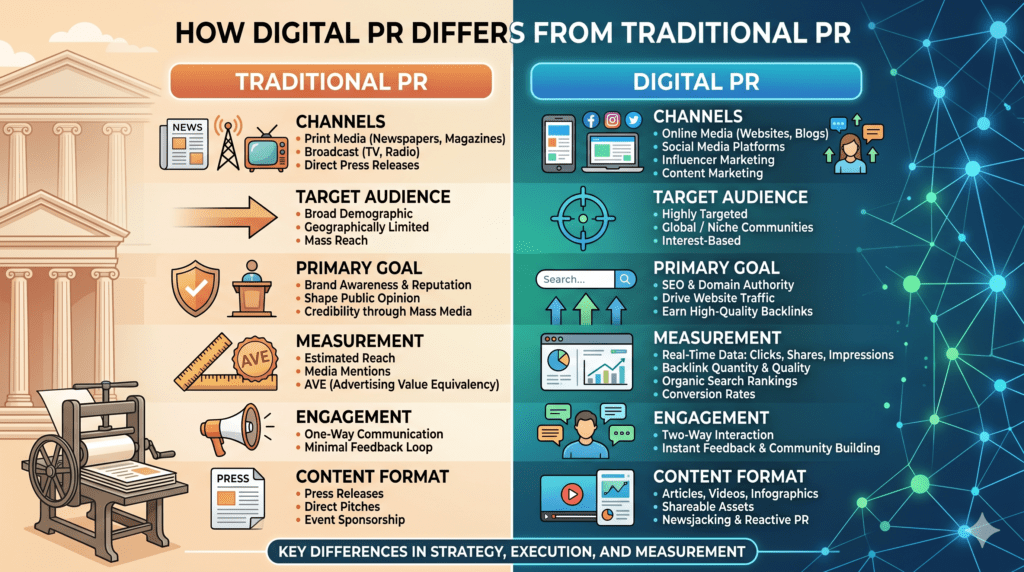
Major Differences Between Digital PR and Traditional PR
1. Communication Channels
- Traditional PR: Newspapers, TV, radio, magazines, and events.
- Digital PR: Blogs, social media, online news portals, podcasts, and websites.
2. Audience Reach
- Traditional PR: Limited to the audience of a specific media outlet.
- Digital PR: Global reach through internet platforms.
3. Measurement and Analytics
- Traditional PR: Difficult to measure exact impact.
- Digital PR: Easily measurable through analytics tools such as website traffic, backlinks, engagement metrics, and conversions.
4. Cost Efficiency
- Traditional PR: Often expensive due to advertising and media placements.
- Digital PR: More cost-effective and scalable.
5. Speed of Communication
- Traditional PR: Slower due to publication schedules.
- Digital PR: Instant communication through online platforms.
6. Interaction with Audience
- Traditional PR: One-way communication.
- Digital PR: Two-way communication where audiences can comment, share, and engage with brands.
Benefits of Digital PR for Businesses
Improved Online Visibility
Digital PR helps brands appear in search engine results, increasing website traffic and awareness.
Stronger Brand Authority
High-quality online mentions and backlinks build credibility and trust.
Better Audience Engagement
Social media and digital platforms allow businesses to interact directly with customers.
SEO Benefits
Backlinks from reputable websites improve domain authority and search engine rankings.
Why Businesses Should Combine Both PR Strategies
Although digital PR is becoming dominant, traditional PR still holds value in many industries. A combined PR strategy ensures maximum reach and credibility.
For example:
- Traditional media coverage builds brand prestige.
- Digital PR strengthens online presence and SEO.
When both strategies work together, organizations can reach broader audiences and maintain strong brand recognition.
Conclusion
Digital PR and Traditional PR share the same core objective—building and maintaining a positive brand image—but they differ significantly in their tools, reach, and measurement capabilities. While traditional PR focuses on offline media and long-established channels, digital PR leverages the power of the internet, SEO, social media, and online publications.
In today’s digital world, businesses that embrace digital PR strategies alongside traditional methods can achieve better visibility, engagement, and long-term growth.
For businesses looking to improve their online presence, SEO performance, and digital marketing strategy, professional digital services are essential. If you need expert assistance in website development, SEO optimization, and digital marketing, visit TechsterTech at
https://techstertech.com/
TechsterTech provides advanced digital solutions that help businesses grow their online visibility and reach the right audience effectively.