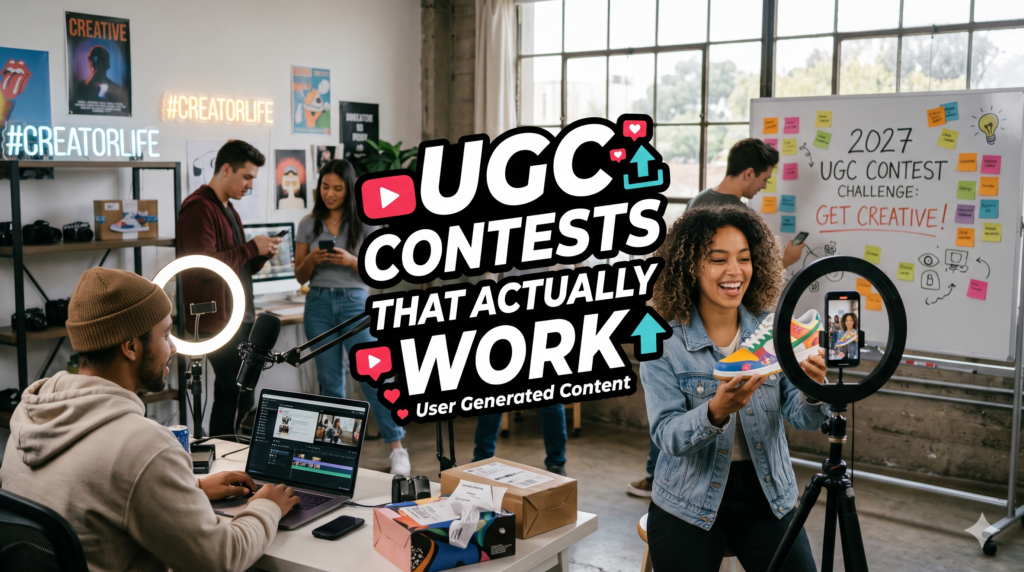
User-generated content (UGC) has become one of the most effective ways for brands to build trust, increase engagement, and create meaningful relationships with their audiences. Instead of relying entirely on professionally produced advertisements, businesses can encourage customers to create and share content based on their real experiences with a product, service, or brand.
One practical way to generate this content is through UGC contests. These campaigns invite customers and followers to participate in creative challenges by sharing photographs, videos, reviews, stories, or other content for a chance to win a reward.
However, not every UGC contest delivers meaningful results. Some attract entries but fail to generate sales, while others receive little participation because the instructions are complicated or the rewards are not appealing.
The secret is to design contests that are simple, relevant, rewarding, and connected to clear marketing objectives.
In this guide, we will explore UGC contest ideas that actually work, how to organise them, which platforms and tools to use, and how businesses can measure their success.
1. What Is a UGC Contest?
A UGC contest is a marketing campaign in which a brand encourages its customers, followers, or community members to create and submit content related to the brand.
Participants may be asked to:
- Share photographs featuring a product.
- Create short videos demonstrating how they use a service.
- Submit creative product reviews.
- Share personal experiences or success stories.
- Participate in a themed challenge.
- Post tutorials, tips, or creative interpretations of a brand’s campaign.
For example, a fitness brand might ask customers to share their workout transformation stories, while a travel company could invite followers to submit photographs from their favourite destinations.
The brand can then select winners based on creativity, relevance, judging criteria, or a combination of public voting and expert evaluation.
2. Why Do UGC Contests Work?
UGC contests work because they turn customers from passive viewers into active participants.
Instead of simply watching advertisements, people become involved in creating and sharing brand-related content.
Some important benefits include:
Builds customer trust: Authentic customer experiences can help prospective buyers understand how products and services perform in real situations.
Increases social engagement: Creative challenges encourage comments, shares, mentions, and participation.
Generates marketing content: Brands can collect photographs, videos, testimonials, and other content that may be useful in future campaigns, subject to appropriate permissions.
Expands brand visibility: Participants may share their entries with friends, family, and followers, increasing the campaign’s organic reach.
Strengthens customer relationships: Recognition and rewards make participants feel valued and connected to the brand.
Supports product discovery: When customers demonstrate how they use a product, other potential buyers may discover practical applications they had not previously considered.
3. Seven UGC Contest Ideas That Actually Work
The best contest format depends on your audience, product, marketing objective, and preferred platform. Here are seven practical ideas businesses can adapt.
1. The Customer Photo Challenge
Ask customers to upload photographs featuring your product or showing how they use your service.
For example, a clothing brand could launch a campaign asking customers to share their favourite outfit featuring an item purchased from the brand.
Participants can use a campaign-specific hashtag and tag the official account.
Why it works: Photographs are easy to create, understand, and share. This format is particularly useful for fashion, food, travel, lifestyle, and retail brands.
2. The Short-Video Challenge
Encourage participants to create short videos demonstrating a product, sharing a tip, or explaining their experience.
For example, a skincare company could invite customers to create a short video explaining their skincare routine using its products.
Brands can promote the campaign through Instagram Reels, YouTube Shorts, and TikTok where available.
Why it works: Short videos can demonstrate products in action and provide more context than a simple photograph.
3. The Before-and-After Contest
Ask participants to share their progress or transformation through before-and-after photographs or videos.
This format can work for:
- Fitness and wellness businesses.
- Home improvement companies.
- Interior design brands.
- Educational platforms.
- Personal development services.
Why it works: Transformation stories are naturally engaging and help audiences understand the possible value of a product or service.
Brands should avoid misleading claims and should obtain permission before publishing identifiable customer content.
4. The Creative Caption Contest
Share a product photograph, campaign image, or short video and ask followers to write the most creative caption.
The brand can select winners based on originality, humour, relevance, and creativity.
Why it works: Participation requires very little effort. This makes it a useful format for brands that want to increase comments and interaction.
5. The Customer Story Contest
Invite customers to share a personal experience involving your brand.
For example, an educational company could ask students to describe how a course helped them develop a new skill.
A travel company might ask customers to share their most memorable travel experience.
Why it works: Stories create emotional connections and help communicate the human value behind a brand.
6. The Community Challenge
Create a challenge that encourages people to participate over several days or weeks.
Examples include:
- A 7-day fitness challenge.
- A 10-day photography challenge.
- A 30-day reading challenge.
- A weekly cooking challenge.
- A sustainable-living challenge.
Participants can upload their progress using a campaign hashtag.
Why it works: Recurring participation can keep a campaign active for longer and help develop a community around a shared interest.
7. The Product Innovation Contest
Ask customers to suggest new product ideas, features, designs, or improvements.
For example, a food brand could invite customers to suggest a new flavour, while a technology company could ask users to recommend features for its next product update.
Why it works: It gives customers a voice in product development and can provide businesses with useful feedback and ideas.
4. How to Design a UGC Contest That Gets Participation
A successful contest requires more than an attractive prize. The campaign should be easy to understand and simple to enter.
Follow these steps:
Step 1: Define Your Objective
Start by identifying what you want to achieve.
Possible objectives include:
- Increasing brand awareness.
- Generating customer content.
- Improving social media engagement.
- Collecting product reviews.
- Increasing website traffic.
- Supporting a product launch.
- Building a community.
- Generating qualified leads.
Avoid trying to achieve every objective through one campaign. Select one primary goal and a few supporting metrics.
Step 2: Understand Your Audience
Consider what your target audience enjoys creating and sharing.
A younger audience may prefer short-form videos, while a professional audience may respond better to case studies, industry insights, or educational content.
Choose a contest format that matches the audience’s interests and content-creation habits.
Step 3: Make Participation Simple
Complicated entry requirements can discourage participation.
A straightforward entry process could be:
- Follow the brand’s official social media account.
- Create a photograph or video based on the campaign theme.
- Publish the content using the campaign hashtag.
- Tag the official brand account.
- Submit the entry through the designated campaign page if required.
Only include requirements that genuinely support your campaign objective. Avoid unnecessary steps.
Step 4: Offer Relevant Rewards
The prize should appeal to the people you want to attract.
Examples include:
- Free products or services.
- Gift vouchers.
- Exclusive discounts.
- Premium subscriptions.
- Event tickets.
- Product bundles.
- Recognition on the brand’s official channels.
A relevant reward can attract participants who are genuinely interested in the brand rather than people who only want expensive prizes.
Step 5: Set Clear Rules and Deadlines
Publish the contest rules before accepting entries.
Include:
- Eligibility requirements.
- Contest opening and closing dates.
- How participants can enter.
- Entry limits.
- Selection criteria.
- Prize details.
- Winner announcement date.
- Content ownership and usage permissions.
- Disqualification conditions.
- Any applicable legal or platform requirements.
Make the rules accessible and easy to understand.
Step 6: Promote the Contest
Do not rely on a single social media post.
Promote the campaign through:
- Instagram Stories and Reels.
- Facebook posts and groups where permitted.
- YouTube Shorts.
- Email newsletters.
- Website banners.
- Blog articles.
- Existing customer communities.
- Influencer collaborations.
Use consistent campaign messaging so participants understand how to enter.
Step 7: Recognise Participants
A successful campaign should not focus exclusively on the winner.
Consider featuring selected entries, thanking participants, sharing community highlights, and publishing a campaign recap.
Recognition can motivate participants and encourage future engagement.
5. Best Platforms for Running UGC Contests
Different platforms support different types of user-generated content. Select the platform based on your audience and campaign format.
| Platform | Suitable contest formats |
|---|---|
| Photo contests, Reels, Stories and hashtags | |
| Community contests, photographs and customer stories | |
| YouTube | Product demonstrations, tutorials and video challenges |
| TikTok | Short-video challenges and creative trends, where available |
| Photography, design and inspiration-based contests | |
| Brand website | Photo submissions, reviews, written stories and structured entries |
Useful official platform resources:
Important: Platform availability and promotional rules can vary by country and change over time. Review the applicable platform policies before launching a contest. For example, Instagram promotions should follow its Promotion Guidelines.
6. Useful Tools to Manage UGC Contests
Managing a contest manually can become difficult when entries increase. The right tools can help businesses create campaign content, collect submissions, monitor performance, and organise participant information.
Here are some useful options:
Canva: Create contest posters, promotional graphics, social media templates, and announcement designs.
Website: https://www.canva.com/
Google Forms: Collect participant details, submission links, consent confirmations, and other required information.
Website: https://forms.google.com/
Google Sheets: Organise entries, track eligibility, maintain judging scores, and prepare winner records.
Website: https://sheets.google.com/
Meta Business Suite: Manage eligible Facebook and Instagram business accounts, publish content, and review available performance insights.
Website: https://business.facebook.com/
Mailchimp: Communicate with subscribers and promote campaigns through email marketing, subject to appropriate consent.
Website: https://mailchimp.com/
Google Analytics 4: Measure website traffic and relevant conversion events generated by campaign activities.
Website: https://analytics.google.com/
The tools you choose should match your campaign size. A small business may only need Google Forms and Google Sheets, while a larger campaign may require dedicated UGC management software.
7. How to Measure the Success of a UGC Contest
A contest should be evaluated using measurable marketing outcomes rather than likes alone.
Track the following metrics:
| Metric | What it measures |
|---|---|
| Total entries | Number of valid submissions |
| Participation rate | Percentage of invited or reached users who participate |
| Engagement rate | Interactions generated by campaign content |
| Reach | Number of unique accounts exposed to the campaign |
| Impressions | Total number of content displays |
| Hashtag usage | Number of relevant campaign hashtag posts |
| Website traffic | Visitors referred to the campaign or product pages |
| Conversion rate | Percentage of visitors completing a desired action |
| Cost per entry | Campaign expenditure divided by valid entries |
| Reusable content | Number of submissions approved for future brand use |
For example, if a campaign costs ₹10,000 and generates 200 valid entries, the cost per entry is:
₹10,000 ÷ 200 = ₹50 per entry
This figure helps evaluate campaign efficiency, but it should be considered alongside content quality, audience relevance, and business outcomes.
Use Google Analytics 4 to monitor relevant website activity and conversions. Where possible, use campaign-specific URLs and UTM parameters to distinguish contest traffic from other marketing sources.
8. Common UGC Contest Mistakes to Avoid
Even well-planned contests can underperform when businesses overlook important details.
Offering irrelevant prizes: Expensive prizes may attract entries from people who have little interest in your brand.
Making participation complicated: Too many entry steps reduce the likelihood of participation.
Ignoring content quality: A large number of submissions does not automatically mean the campaign generated useful marketing content.
Failing to promote the contest: Even an excellent contest needs visibility through suitable channels.
Not defining judging criteria: Unclear selection methods can create confusion and damage trust.
Ignoring content permissions: Publicly available social media content is not automatically free for a brand to reuse in advertisements or other marketing materials.
Choosing vanity metrics over business outcomes: Likes and impressions are useful indicators, but they do not necessarily demonstrate leads, sales, or customer loyalty.
Failing to announce winners: Publish the results according to the promised schedule and communicate with winners through appropriate channels.
9. Legal, Privacy and Content Rights Considerations
UGC contests involve content created by individuals, so businesses should establish clear rules for handling submissions.
Before launching a campaign, consider the following:
- Obtain permission before using participant content in advertisements, websites, brochures, or other promotional materials.
- Explain how submitted content may be used, where it may appear, and for how long.
- Clarify whether participants retain ownership of their original content.
- Obtain appropriate consent before collecting or publishing personal information.
- Provide clear eligibility, selection, and prize conditions.
- Disclose sponsored or incentivised participation where required.
- Follow applicable consumer protection, privacy, advertising, and contest laws.
- Review the promotional policies of every platform used.
For campaigns in India, businesses should consider applicable requirements under the Digital Personal Data Protection Act, 2023 and relevant rules and regulations in force at the time of the campaign. Legal advice may be appropriate for large-scale promotions, prize competitions, or campaigns involving significant data collection.
10. Example: A 14-Day UGC Contest Campaign
Here is a simple campaign structure that a small business can adapt.
Campaign name: Share Your Experience Challenge
Objective: Generate authentic customer content and increase brand engagement.
Duration: 14 days.
Entry method: Participants share a photograph or short video featuring their experience with the brand, use the campaign hashtag, and submit the post link through a campaign form.
Reward: A product voucher or a relevant brand gift hamper.
Winner selection: A judging panel evaluates eligible entries based on creativity, originality, relevance, and adherence to the rules.
Campaign schedule
| Day | Activity |
|---|---|
| 1–2 | Announce the contest and publish the rules |
| 3–5 | Promote the campaign through social media and email |
| 6–8 | Share selected entries with permission |
| 9–11 | Publish reminders and encourage participation |
| 12–13 | Close submissions and verify eligible entries |
| 14 | Announce the winner and thank participants |
After the contest, review the performance data, collect feedback, and identify content that participants have authorised the brand to reuse.
Conclusion
UGC contests can be much more than short-term social media engagement campaigns. When planned strategically, they help businesses build trust, encourage customer participation, generate authentic content, and strengthen brand communities.
The most effective contests have a clear objective, simple participation requirements, relevant rewards, transparent rules, and measurable outcomes. Businesses should also respect participant privacy and obtain appropriate permissions before reusing submitted content.
For small businesses, startups, and growing brands, UGC contests offer an accessible way to involve customers in marketing activities without depending entirely on expensive advertising campaigns.
Need help building a stronger digital marketing strategy?
TechsterTech helps businesses strengthen their online presence through website design and development, SEO, website optimisation, maintenance, e-commerce solutions, and IT consultancy.
Whether you want to create a dedicated contest landing page, improve your website’s conversion rate, or develop a complete digital marketing strategy, TechsterTech can help you turn creative campaigns into practical business opportunities.